
Ann Arbor Property Tax Records
Ann Arbor property tax records are maintained by the City Assessor's Office and searchable through the BS&A Online portal. Located in Washtenaw County with about 123,000 residents, Ann Arbor manages its own assessment process while the Washtenaw County Treasurer handles tax collections. This page covers how to look up Ann Arbor property tax records online, how the city's assessment process works, what exemptions are available to owners, how to file an appeal, and what to do if taxes go unpaid.
Ann Arbor Overview
How to Search Ann Arbor Property Tax Records
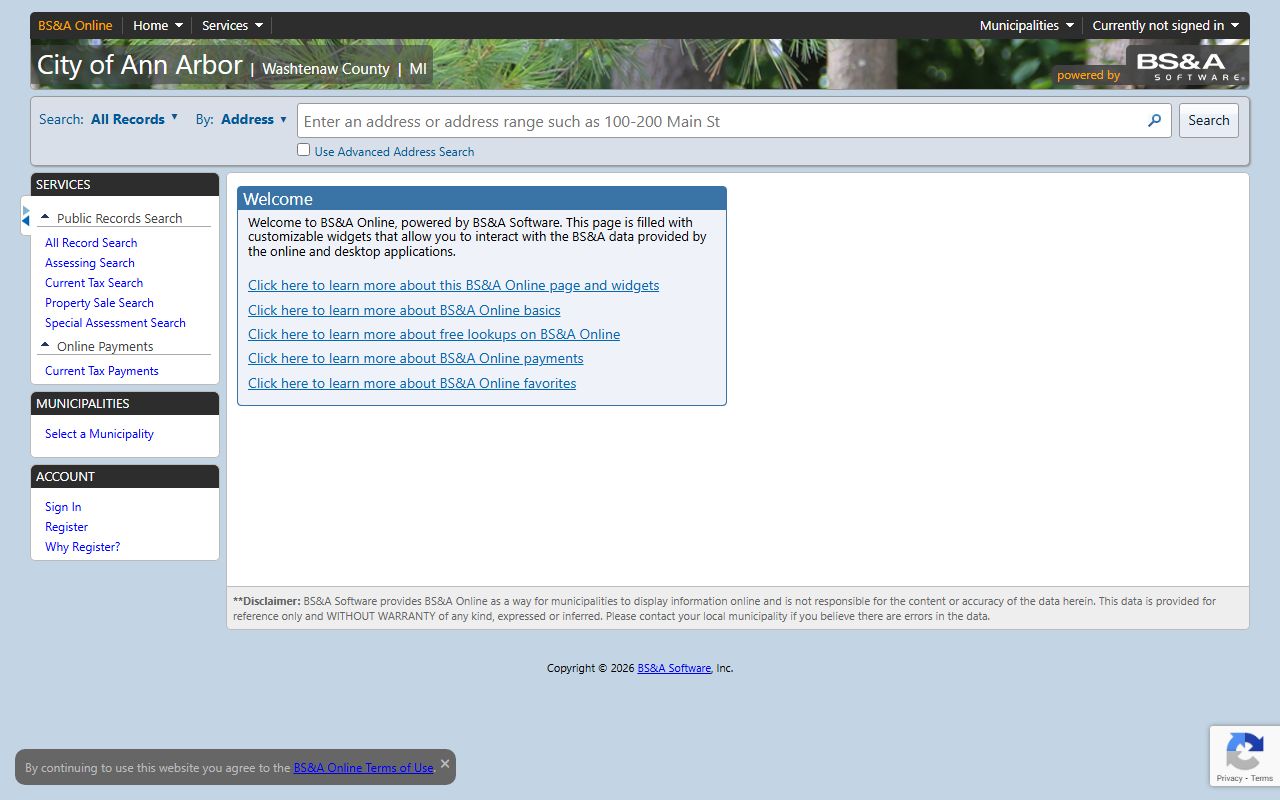
Ann Arbor uses the BS&A Online portal for Ann Arbor as its primary public records search tool. No account is needed for basic parcel lookups. You can search by owner name, property address, or parcel number. Each record shows the current owner, assessed value, taxable value, property class, legal description, sales history, and building characteristics. The portal is available any time and reflects current assessment year data.
The City of Ann Arbor also maintains an Open Data Portal and interactive GIS maps tied to the Assessor's parcel data. These tools let you view property boundaries, cross-reference records with aerial imagery, and look up related data such as zoning and permits. The A2Trak building permitting archive is another resource for researching permit history on Ann Arbor parcels. Together, these tools give you a more complete picture of a property than the BS&A portal alone. For FOIA records requests, visit the Ann Arbor FOIA page.
The screenshot below shows the BS&A Online portal used by Ann Arbor. This is the main search tool for Ann Arbor property tax records.
If the online portal does not have what you need, contact the Assessor's Office directly during business hours.
Ann Arbor Assessor's Office
The Ann Arbor Assessor's Office sits on the fifth floor of Larcom City Hall. The office is responsible for setting assessed values for all real and personal property within city limits each year. Under MCL 211.1, Michigan law requires that all property be assessed at 50% of its true cash value. The office maintains parcel maps, processes exemption applications, and prepares assessment rolls that feed into the county tax collection process. Ann Arbor's Assessor's Office does not collect taxes; collection is handled by the Washtenaw County Treasurer.
| Office | City of Ann Arbor Assessor's Office |
|---|---|
| Address | Larcom City Hall, 5th Floor 301 E. Huron St. Ann Arbor, MI 48104 |
| Phone | 734-794-6530 |
| assessor@a2gov.org | |
| Fax | 734-997-1437 |
| Hours | Mon-Fri: 8:00 AM - 5:00 PM |
| Website | Ann Arbor Assessor's Office |
| Online Search | BS&A Online - Ann Arbor |
The Assessor's Office maintains property line maps and works with the city's GIS system to keep boundary data current. If you notice an error in your parcel's legal description or boundaries, report it to this office. They also work with the city's Open Data Portal to make GIS-linked parcel data available to the public.
Property Tax Assessment in Ann Arbor
Ann Arbor properties are assessed each year as of December 31 under MCL 211.30. Assessed values must equal 50% of each parcel's true cash value. The taxable value is a separate number, capped each year at the lower of the inflation rate or 5% for as long as the same owner holds the property. When a transfer occurs, the taxable value uncaps and resets to the assessed value the following year. Ann Arbor has a competitive real estate market, and the difference between assessed and taxable value can be substantial for long-term owners. Buyers should review the current assessed value through the BS&A portal before closing, since their tax bill the year after purchase may be higher than what the previous owner paid.
Assessment notices go out during the first week of March. Ann Arbor owners have a specific window to review their values before the Board of Review meets in the third week of March. The Assessor's Office conducts field reviews on a rolling schedule and updates parcel records to reflect current conditions. Historic district considerations may also affect how certain properties are assessed in Ann Arbor, given the number of properties with historic designations within city limits. The Michigan Treasury site provides statewide guidance on assessment law and property owner rights.
Property Tax Exemptions in Ann Arbor
Ann Arbor homeowners can claim the Principal Residence Exemption (PRE) under MCL 211.7u if the property is their primary residence. The PRE removes 18 mills from the school operating tax. File Form 2368 with the Ann Arbor Assessor's Office by June 1. This is one of the most straightforward ways to reduce your property tax bill and applies to owner-occupied residential properties. Check the BS&A portal to confirm the PRE is on your parcel record. If it is missing, file the form as soon as possible.
The Poverty Exemption is available for low-income homeowners who meet income and asset thresholds. You must file Form 5737 and Form 4988 with the Assessor's Office. The March Board of Review considers these requests each year. Farmland exemptions exist under state law but are less common within Ann Arbor city limits than in surrounding Washtenaw County townships. Historic district considerations are worth asking about if your property has a historic designation, as certain assessment rules may apply differently. If you are unsure which exemptions apply to your situation, call the Assessor's Office at 734-794-6530.
Note: The PRE is not automatic. You must file it once, and the exemption stays in place until ownership or use changes.
Appealing Your Ann Arbor Assessment
The Ann Arbor Board of Review meets for four days during the third week of March each year. Assessment notices go out the first week of March, giving owners about two weeks to review their values and decide whether to appeal. Appointments are required for the Board of Review, so contact the Assessor's Office early in March to get scheduled. Once you have an appointment, prepare your evidence. Comparable sales for similar properties in Ann Arbor, a recent appraisal, or documentation of conditions that reduce value all support your case.
If the Board of Review does not resolve the dispute, you can escalate to the Michigan Tax Tribunal. The MTT is a state-level body that hears appeals from property owners across Michigan. For residential property, the filing deadline is July 31. For commercial property, the deadline is May 31. The Property Taxpayer's Bill of Rights under MCL 205.735 outlines your rights at each stage. The MTT can be reached at 517-335-9760. Ann Arbor's active real estate market makes assessment accuracy especially important, and the appeal process exists to correct errors when they occur.
Property Tax Payments in Ann Arbor
The City of Ann Arbor's Assessor's Office establishes property values but does not collect taxes. Tax collection is handled by the Washtenaw County Treasurer after the city issues bills. Summer and winter tax bills go out on state-standard schedules. If you have questions about your current bill or payment options, contact the Washtenaw County Treasurer's office. Delinquent taxes also flow through the county treasurer, which handles collection for all municipalities within Washtenaw County.
Delinquent taxes in Michigan accrue interest and fees under state law, and unpaid balances can eventually trigger the forfeiture and foreclosure process. Ann Arbor property owners who have fallen behind on taxes should contact the Washtenaw County Treasurer promptly. The county can explain the current balance, applicable fees, and whether payment plans or other options are available. The Michigan Treasury site also has information on delinquent tax procedures statewide.
Washtenaw County Property Tax Records
Ann Arbor is in Washtenaw County. All property tax records for the city ultimately connect to the Washtenaw County system. Visit the county page for equalization office information, GIS tools, Register of Deeds access, and resources that cover the full county area.
Nearby Cities
Ann Arbor is in Washtenaw County. No other qualifying Michigan cities with property tax records pages are located immediately adjacent to Ann Arbor. For property records across the broader county area, visit the Washtenaw County property tax records page.