
Lansing Property Tax Records Lookup
Lansing property tax records are managed by the City Assessor's Office and can be searched online through the BS&A Online portal. Michigan's state capital, with about 112,000 residents, handles property assessment through its own city office while tax collection runs through both the City Treasury and the Ingham County Treasurer. Whether you need current assessed values, tax payment history, or ownership details for a Lansing parcel, this guide walks you through the tools and offices that manage property tax records in the city.
Lansing Overview
How to Search Lansing Property Tax Records
Lansing property tax records are publicly available through the BS&A Online portal for Lansing. No account is needed for basic searches. You can look up parcels by property address, owner name, or parcel number. Each result shows the current owner, legal description, assessed value, taxable value, property class, and tax history. The system covers all parcels within Lansing city limits and is updated regularly to reflect current assessment data.
The City of Lansing's website also maintains a dedicated property tax page at lansingmi.gov/595/Property-Tax, which links to the BS&A portal and provides additional context on how city property taxes work. The city uses GIS resources and Ingham County GIS integration to keep property maps current. If you need to see parcel boundaries or cross-reference a property with other data, Ingham County GIS tools complement the BS&A lookup well.
The screenshot below shows the BS&A Online interface for Lansing. This portal is your main starting point for searching Lansing property tax records.
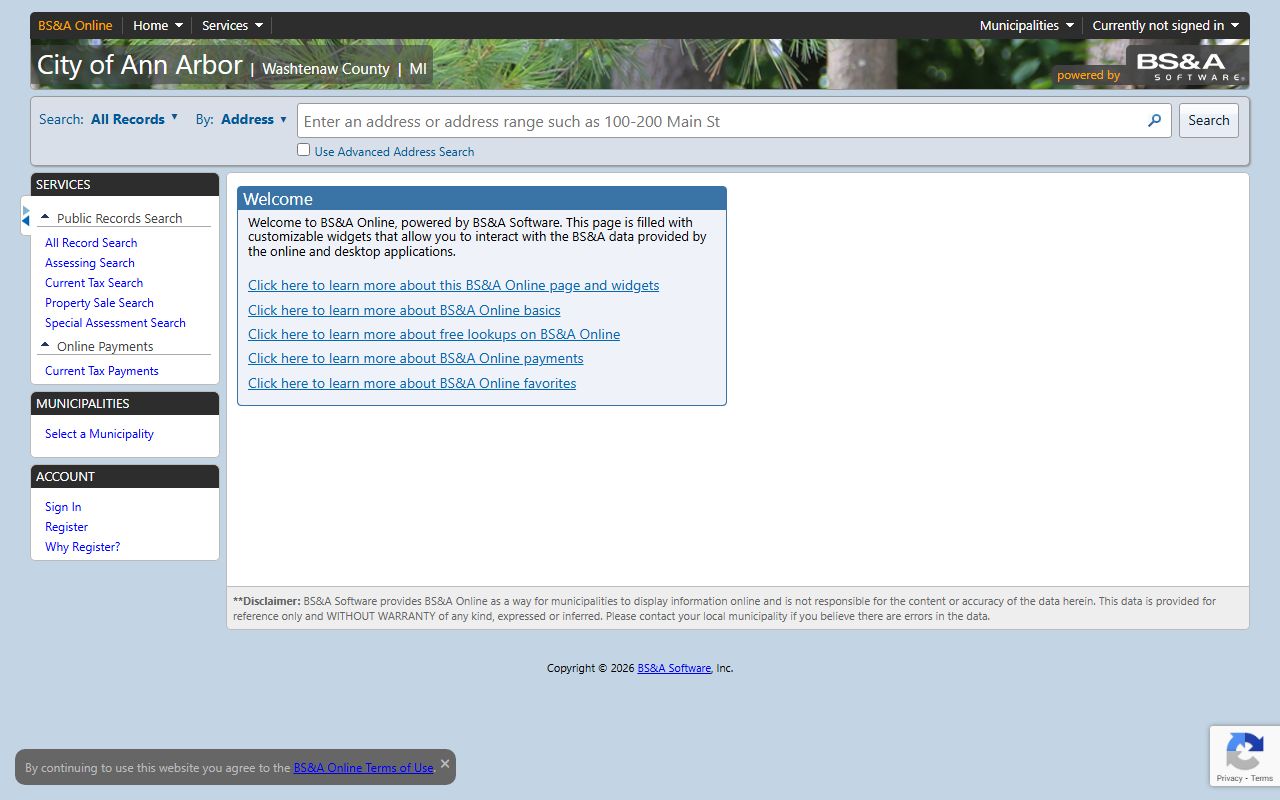
For records that the portal cannot provide, contact the Lansing City Assessor's Office directly during business hours.
Lansing Assessor's Office
The Lansing City Assessor's Office handles all property assessments within the city under the requirements of MCL 211.1, which mandates that all Michigan property be assessed at 50% of its true cash value. Assessors conduct field reviews, maintain parcel records, and process exemption filings. The office is located in Lansing City Hall on W Michigan Avenue. A staff directory is available at the city's neighborhood services page. Tax collection for current bills is handled through the City Treasury at (517) 483-4121, while delinquent taxes flow to the Ingham County Treasurer.
| Office | City of Lansing Assessor's Office |
|---|---|
| Address | City Hall, 124 W Michigan Avenue Lansing, MI 48933 |
| Assessor Phone | 517-483-7624 |
| Treasury Phone | 517-483-4121 |
| Assessor Fax | 517-483-4101 |
| assessor@lansingmi.gov | |
| Property Tax Page | Lansing Property Tax Info |
| Assessor Staff | City Assessor Staff |
| Online Search | BS&A Online - Lansing |
The Ingham County Treasurer's office at 313 W. Kalamazoo, Lansing, MI 48933, handles delinquent tax collections for all Ingham County municipalities, including Lansing. The county treasurer can be reached at (517) 676-7233. For current city tax bills and payment options, the City of Lansing Treasury and Income Tax Office is at lansingmi.gov/171/Treasury-Income-Tax-Office.
Property Tax Assessment in Lansing
All Lansing properties are valued each year as of December 31 under MCL 211.30. The assessed value must equal 50% of the property's true market value. The taxable value is a separate figure that is capped each year at the lower of the inflation rate or 5% for as long as ownership does not change. For owners who have held a Lansing property for several years, the taxable value may be substantially lower than the assessed value, which keeps the annual tax bill lower than it would otherwise be. When a property transfers, the taxable value uncaps and resets to the assessed value in the next tax year.
Lansing has a mixed property base that includes residential neighborhoods, state government complexes, commercial areas, and institutional properties. The Assessor's Office reviews field data annually and updates parcel records accordingly. Assessment notices go out in February. If you believe your property's record is out of date, perhaps because of demolition, fire damage, or other changes to the structure, contact the Assessor's Office to request a review. Accurate records lead to accurate assessments. The Michigan Treasury site explains the statewide framework that governs all Michigan city and township assessors.
Note: Address change requests can be faxed to the Lansing Assessor at 517-483-4101 to keep records current.
Property Tax Exemptions in Lansing
Lansing homeowners can claim the Principal Residence Exemption (PRE) under MCL 211.7u if the property is their main home. The PRE removes 18 mills from the school operating tax, which is a meaningful reduction on the annual bill. File Form 2368 with the Lansing Assessor's Office by June 1. If you have recently purchased a home in Lansing, check the BS&A portal to confirm the PRE is on your record. If it is not, file the form immediately so the exemption takes effect for the next tax year.
The Poverty Exemption is also available for low-income Lansing homeowners. You must file Form 5737 and Form 4988 with the Assessor's Office before the March Board of Review. Income and asset tests determine eligibility, and the Board decides on each application during March. Disabled veterans may qualify for a full property tax exemption under Michigan law. The Assessor's Office can tell you what documentation you need to apply. City-specific programs may also exist from time to time, so it is worth asking the Assessor's Office directly what is currently available in Lansing.
Appealing Your Lansing Assessment
Lansing property owners who disagree with their assessed value can challenge it through the March Board of Review. The Board meets each year to hear protests from property owners within the city. You can attend in person or submit a written protest before the deadline. Having solid evidence matters. Bring a recent appraisal, comparable sales data from similar Lansing properties, or other documentation that supports a lower market value. Without evidence, the Board has less reason to change the assessment.
If the Board of Review does not resolve your appeal, you can file with the Michigan Tax Tribunal. The MTT deadline is July 31 for residential property and May 31 for commercial property. The Tribunal provides a formal hearing process that is independent of the city. The Property Taxpayer's Bill of Rights under MCL 205.735 protects your rights at each step. The MTT can be reached at 517-335-9760. Lansing's location in Ingham County means the county's equalization data is also relevant when building your appeal, since equalization ratios affect assessed values citywide.
Property Tax Payments in Lansing
Lansing property taxes are billed in summer and winter installments. The City of Lansing Treasury and Income Tax Office handles current tax payments. Contact Treasury at 517-483-4121 or visit the city Treasury page for payment options. Once taxes become delinquent, they transfer to the Ingham County Treasurer at tr.ingham.org, located at 313 W. Kalamazoo, Lansing, MI 48933, phone (517) 676-7233. The county handles delinquent collections and may offer payment arrangements depending on the balance and history.
Michigan's delinquent tax process gives owners several years before a property reaches foreclosure, but fees and interest accumulate fast. Lansing owners who are behind on taxes should contact the Ingham County Treasurer sooner rather than later to get a current balance and understand the options. Acting before the forfeiture date saves money and preserves more choices for resolving the debt.
Ingham County Property Tax Records
Lansing is in Ingham County. All property tax records for the city ultimately connect to the Ingham County system. Visit the county page for equalization office information, GIS tools, Register of Deeds access, and resources that cover the full county area.
Nearby Cities
Lansing is the county seat of Ingham County. No other qualifying Michigan cities with property tax records pages are located immediately adjacent to Lansing. For property records across the broader county area, visit the Ingham County property tax records page.