
Troy Property Tax Records
Troy property tax records are maintained by the City Assessor and are publicly accessible through the BS&A Online portal. Troy is an Oakland County city with around 87,000 residents and a significant commercial and corporate presence. Property owners, prospective buyers, and researchers can use the online portal to find parcel data, assessed values, taxable values, and tax billing history for any property in Troy. This page explains how to search those records, what the City Assessor handles, and how the appeal and payment processes work.
Troy Overview
How to Search Troy Property Tax Records
Troy uses the BS&A Online platform to give the public access to property tax records. You can search by owner name, parcel number, or property address. Results show the current assessed value, taxable value, ownership details, and tax history for each parcel in the city. No account is needed for a basic search.
To search, go to the Troy BS&A property tax search portal. Enter the information you have in the search box. If you know the parcel ID, that gives the most direct result. Address searches work well too. The portal lets you drill into individual parcel pages that show current and prior year assessment data, billing details, and any exemptions on file. This makes it useful not just for tax questions but also for verifying ownership and checking whether a Principal Residence Exemption is in place before you buy.
The screenshot below shows the Troy BS&A Online portal. This is the city's main public tool for searching property tax records and parcel data.
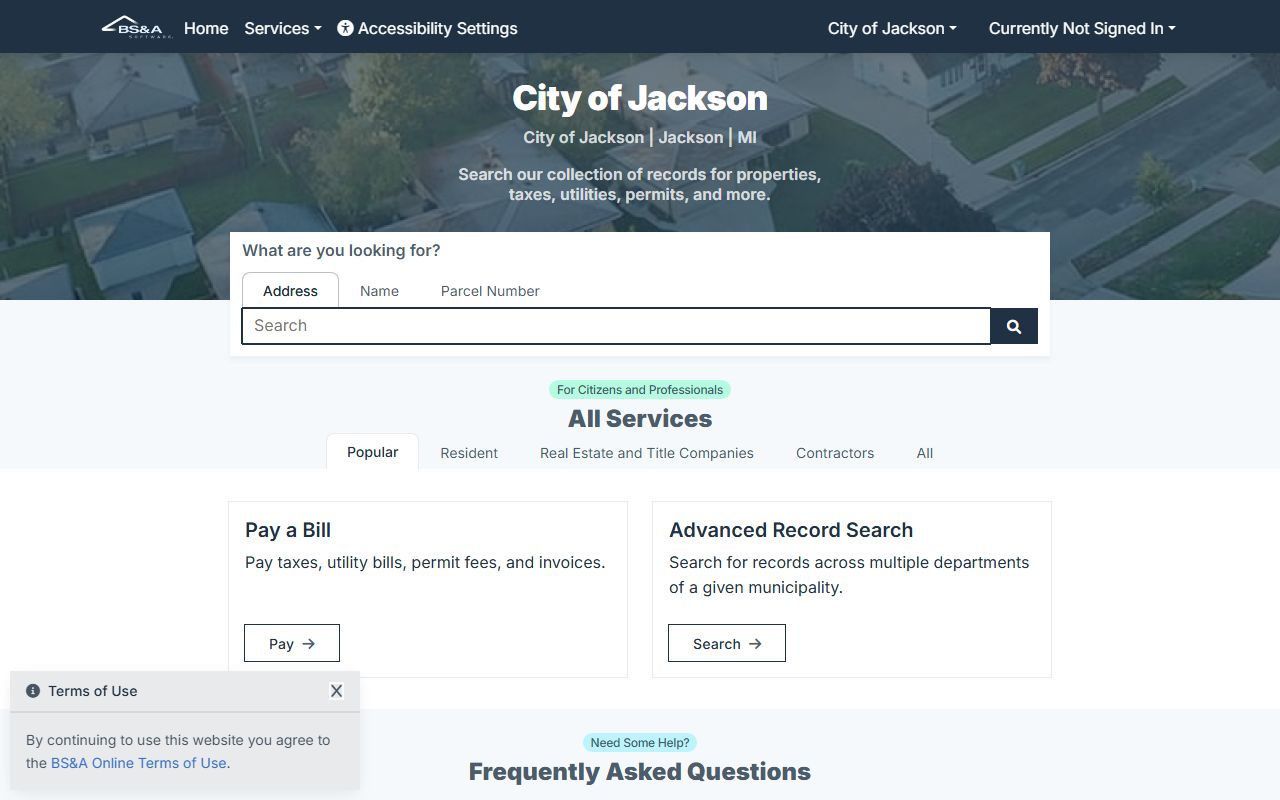
The portal is maintained by the city and updated throughout the year to reflect current assessment and billing data.
For in-person help or records not available online, visit the Troy City Hall at 500 W. Big Beaver Road. The Assessor's office is in the building and handles walk-in requests during regular business hours. The city's official website at troymi.gov also has contact information and links to city services. Troy also integrates with the Oakland County GIS system, which lets you view parcel boundaries and aerial imagery alongside the tax data.
Troy City Assessor's Office
The Troy City Assessor is responsible for valuing all real and personal property within city limits each year. This is required under MCL 211.1. Troy has a large and diverse tax base that includes residential neighborhoods, high-value commercial corridors, and major corporate campuses. The assessor values all of these property types using methods that comply with state guidelines. Assessment notices are mailed to all property owners each February and show both the assessed value and the taxable value for the year.
The office processes all Principal Residence Exemption applications and reviews Property Transfer Affidavits filed after sales. When you buy property in Troy, you must file Form L-4025 within 45 days of the transfer date. This form is what triggers the uncapping of taxable value in the following tax year. Late filing leads to penalties. The assessor's staff can answer questions about the form and walk you through what to expect after your purchase. Contact the office at (248) 524-3302 or visit City Hall at 500 W. Big Beaver Road.
| Office | City of Troy Assessor's Office |
|---|---|
| Address | 500 W. Big Beaver Road, Troy, MI 48084 |
| Phone | (248) 524-3302 |
| Hours | Monday through Friday, regular business hours |
| Website | troymi.gov |
| Online Search | BS&A Online - Troy |
Property Tax Assessment in Troy
Troy properties are assessed each year as of December 31 under MCL 211.30. State law requires assessment at 50% of true cash value. The Oakland County Equalization Department reviews Troy's assessments each spring to confirm they meet that standard. If the overall level of assessment in Troy is above or below 50%, the county can apply an adjustment to bring the city into compliance. This review process applies to all municipalities in Oakland County.
Troy has a strong real estate market with high property values, particularly in commercial and corporate real estate. The gap between assessed value and taxable value can be significant in Troy, especially for long-term owners. Taxable value grows by no more than inflation or 5% per year, so properties held for many years often have taxable values considerably below their assessed values. When these properties change hands, the taxable value uncaps and resets to the assessed value in the year after the sale. Buyers should plan for this. Use the Michigan Property Tax Estimator before closing to model what your post-purchase tax bill will likely be.
Troy also integrates with Oakland County GIS, making it possible to view parcel maps alongside property tax data. This is helpful for understanding lot dimensions and zoning in relation to assessed values. The Michigan Treasury provides the statewide framework that Troy assessors follow when setting values each year.
Property Tax Exemptions in Troy
Troy homeowners can reduce their property taxes through several exemption programs. The Principal Residence Exemption is the most common. Under MCL 211.7u, the PRE removes 18 mills from the school operating tax if the property is your primary home. File Form 2368 with the Troy City Assessor by June 1. This exemption applies only to your main residence. If you own multiple properties, you can only claim the PRE on the one you live in. Buyers of existing homes should confirm whether the PRE is already in place, and if not, file promptly after moving in.
The Poverty Exemption is another option for Troy homeowners who meet income and asset limits. File Form 5737 and Form 4988 with the City Assessor. The March Board of Review reviews each request. Troy sets its own income guidelines within state parameters, so contact the assessor at (248) 524-3302 to find out if you qualify before the Board of Review session in March.
Oakland County programs may offer additional support for qualifying residents. Disabled veterans who have a 100% service-connected disability rating from the U.S. Department of Veterans Affairs can apply for a full exemption from property taxes under Michigan law. Surviving spouses of qualifying veterans may also be eligible. Call the Troy Assessor's office to get current eligibility details and application instructions. Note: All exemption applications must be filed before the applicable deadlines. Missing the deadline means waiting an entire year to reapply.
Appealing Your Troy Assessment
Troy property owners who disagree with their assessed or taxable value have the right to appeal. The first step is the March Board of Review, which meets each March at Troy City Hall. You can appear in person or file a written protest before the session ends. Bring documentation to support your position. A recent appraisal, a sale price if the property sold recently, or data on comparable sales in Troy are all forms of evidence the board will consider. The stronger the evidence, the better your chance of a successful outcome.
If the Board of Review does not correct the issue, you can file with the Michigan Tax Tribunal. The MTT is the state body that handles property tax disputes. For residential homestead property, the filing deadline is July 31. For commercial and industrial property, it is May 31. Reach the MTT at 517-335-9760. Your rights throughout the process are protected under the Property Taxpayer's Bill of Rights, MCL 205.735. Most cases are resolved through informal negotiation or stipulated agreements before a formal MTT hearing is needed. Filing a petition preserves your right to a resolution while the process runs its course.
Property Tax Payments in Troy
Troy sends summer and winter tax bills each year. Summer taxes are typically due in September. Winter taxes are generally due in February. Pay current-year taxes to the Troy City Treasurer at City Hall, 500 W. Big Beaver Road. You can pay in person, by mail, or online if the city offers that option. Check troymi.gov for current payment methods and exact due dates for each billing period.
Once taxes go unpaid past the local deadlines, they become delinquent and are forwarded to the Oakland County Treasurer. The county then handles all delinquent collections, including payment plans and properties that have entered the forfeiture process. Interest and fees accrue on delinquent balances. Michigan law allows foreclosure on properties with three or more years of unpaid taxes. If you are behind on taxes in Troy, contact the Oakland County Treasurer as soon as possible. The sooner you address it, the lower the total cost and the more options you have to resolve it without losing the property.
Oakland County Property Tax Records
Troy is in Oakland County. County-level property tax resources include the equalization office, Register of Deeds, GIS mapping tools, and the county treasurer. Visit the county page for full details.
Nearby Cities
These nearby Michigan cities also have property tax records pages with local assessor contacts and online search tools.