
Find Property Tax Records in Sterling Heights
Sterling Heights property tax records are managed by the city's Assessor's Office and can be searched online through the BS&A Online portal. Located in Macomb County with about 132,000 residents, Sterling Heights maintains detailed parcel data for all properties within city limits. You can search by parcel ID, street address, or owner name to view assessed values, taxable values, tax history, and building details. This page explains how to access Sterling Heights property tax records, how the assessment process works, and what exemptions and appeal options are available.
Sterling Heights Overview
How to Search Sterling Heights Property Tax Records
The City of Sterling Heights uses BS&A Online to give the public access to property tax records. Go to the Sterling Heights BS&A property search to start your lookup. No account is required for basic searches. The portal supports searches for assessing data, current tax information, property sale history, and special assessment records. This level of detail lets you look at a parcel from multiple angles in one place without having to contact the city office for every question.
Search by parcel ID, street address, or owner name. Results show the current owner, legal description, assessed value, taxable value, and tax history. Building detail data includes square footage, year built, and property class. The sale history tab shows past transfers and prices, which can be useful when comparing values or researching a potential purchase. Online payment is also available through BS&A Online Payment for owners who want to pay taxes without visiting city hall.
The screenshot below shows the BS&A Online portal for Sterling Heights. This is the main tool for finding Sterling Heights property tax records without an in-person visit.
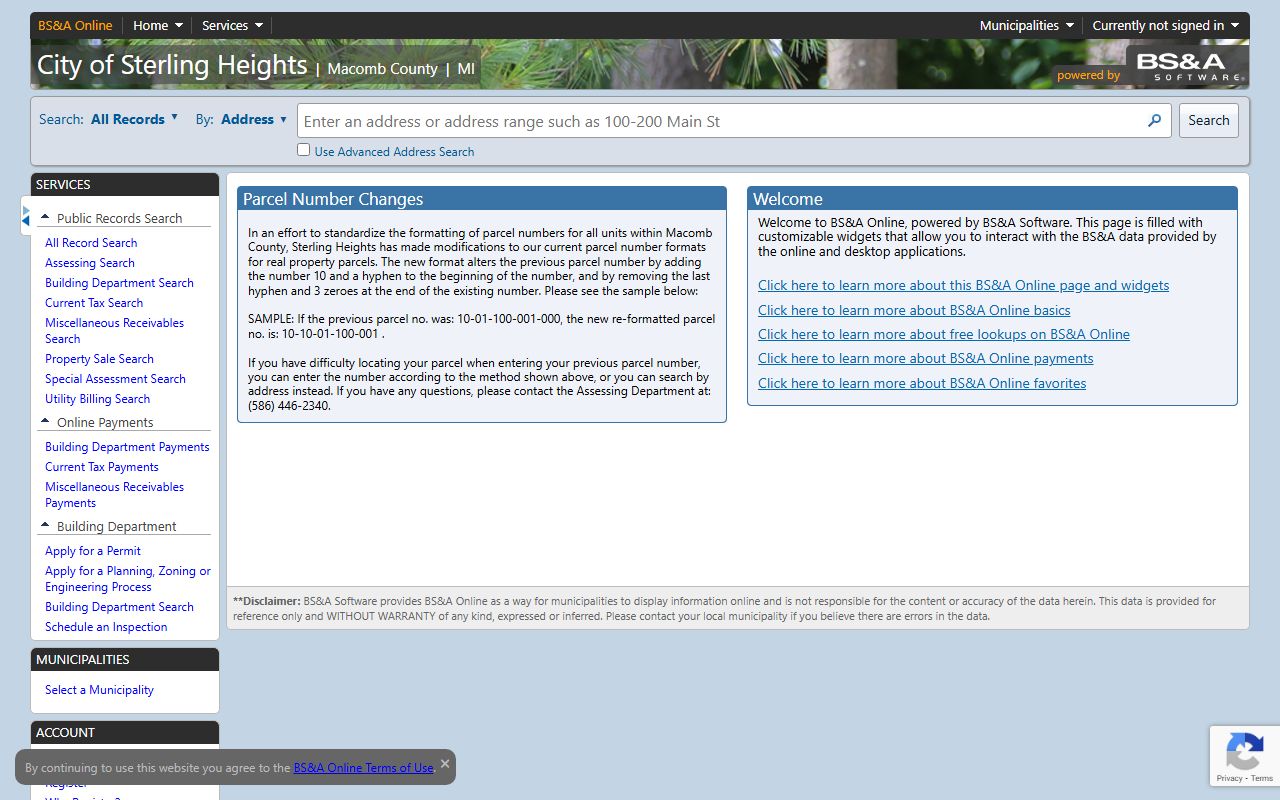
The portal is updated regularly and reflects current-year assessment data for all Sterling Heights parcels.
Sterling Heights Assessor's Office
City Assessor Robin Palazzolo oversees the Sterling Heights Assessor's Office, which is responsible for valuing all real and personal property in the city each year. The office applies the Michigan standard of 50% of true cash value as required by MCL 211.1. The Assessor's Office also processes Principal Residence Exemption filings, Poverty Exemption applications, and other exemption requests. City Treasurer Jia Hang manages tax collection for Sterling Heights. The Assessor and Treasurer work in the same building on Utica Road and can often answer related questions at the same visit.
| Office | City of Sterling Heights Assessor's Office |
|---|---|
| City Assessor | Robin Palazzolo |
| Address | 40555 Utica Road Sterling Heights, MI 48313 |
| Assessor Phone | (586) 446-2340 |
| Treasury Phone | (586) 446-2489 |
| Fax | (586) 276-4077 |
| City Treasurer | Jia Hang |
| Website | City of Sterling Heights |
| Online Search | BS&A Online - Sterling Heights |
The city maintains its own GIS system with interactive property maps and zoning overlays. These maps tie into the parcel data in BS&A and are useful when you need to see a property's exact boundaries or understand zoning classifications. The GIS system is accessible through the city's website.
Property Tax Assessment in Sterling Heights
Sterling Heights properties are assessed each year as of December 31 under MCL 211.30, Michigan's statutory Tax Day. The assessed value must be 50% of the property's true market value. The taxable value is capped at the lower of the inflation rate or 5% per year for as long as the same owner holds the property. This cap is one of the key features of Michigan's property tax system and means that owners who have held a property for many years often have a taxable value well below the assessed value. When the property transfers, the taxable value uncaps and resets to the full assessed value in the next tax year.
Assessment notices go out in February. Sterling Heights homeowners should review their notice carefully each year. If the value seems high relative to what comparable homes are selling for, it is worth gathering evidence before the March Board of Review deadline. The Assessor's Office conducts field reviews on a rotating schedule and updates parcel data as conditions change. If you have made changes to your property, additions, demolitions, or structural modifications, those changes should eventually show up in your assessment. If they have not, contact the Assessor's Office to report the current condition. The Michigan Treasury site has helpful background on how state assessment law works.
Property Tax Exemptions in Sterling Heights
Sterling Heights homeowners can claim the Principal Residence Exemption (PRE) if the property is their main home. Under MCL 211.7u, the PRE removes 18 mills from the school operating tax. File Form 2368 with the Sterling Heights Assessor's Office by June 1. This is a straightforward exemption with a clear deadline and a significant tax impact. If you recently purchased a home in Sterling Heights, check the BS&A portal to confirm the PRE is on record. If it is not, file the form promptly.
The Poverty Exemption is available for low-income homeowners. You must file Form 5737 and Form 4988 with the Assessor's Office. The March Board of Review considers poverty exemption requests annually. NEZ (Neighborhood Enterprise Zone) programs may apply to properties in designated zones within the city, offering tax abatement on qualifying improvements or new construction. If you think your area may be in a NEZ zone, ask the Assessor's Office which zones cover your address and what steps you need to take to apply.
Appealing Your Sterling Heights Assessment
Sterling Heights property owners who disagree with their assessed value can appeal through the March Board of Review. The Board meets each March during set dates. The Assessor's Office recommends having an informal conversation with the assessor before the formal Board hearing, since some issues can be resolved without going through the full review process. If you decide to file a formal protest, bring solid evidence: a recent independent appraisal, comparable sales data for similar homes in Sterling Heights, or documentation of conditions that reduce value.
If the Board of Review does not change your value, you can take your case to the Michigan Tax Tribunal. Residential property owners must file by July 31. Commercial property owners must file by May 31. The MTT is a state-level body that handles property tax appeals from across Michigan and provides a formal hearing process independent of the local city government. Your rights in the appeal process are set out in the Property Taxpayer's Bill of Rights under MCL 205.735. The MTT can be reached at 517-335-9760.
Note: An informal review with the assessor before the Board of Review can save time and sometimes resolves the issue without a formal hearing.
Property Tax Payments in Sterling Heights
Sterling Heights property taxes are billed in two installments: summer and winter. Contact the city Treasury at (586) 446-2489 for current bill amounts and due dates specific to your parcel. Online payment is available through the BS&A Online payment portal, making it easy to pay without visiting city hall. If your payment is more than you expected, double-check whether the PRE is in place and whether the taxable value reset after a recent transfer.
Taxes that are not paid to the city treasurer within the collection period become delinquent and are forwarded to the Macomb County Treasurer. The county handles all delinquent tax collections and payment arrangements. Delinquent taxes accrue interest and fees under Michigan law, and unpaid balances can eventually lead to forfeiture and foreclosure. If you have fallen behind on Sterling Heights property taxes, contact the Macomb County Treasurer as soon as possible to review your options and stop additional charges from building up.
Macomb County Property Tax Records
Sterling Heights is in Macomb County. All property tax records for the city ultimately connect to the Macomb County system. Visit the county page for equalization office information, GIS tools, Register of Deeds access, and resources that cover the full county area.
Nearby Cities
These nearby Michigan cities also have property tax records pages with local assessor information and search resources.