
Arenac County Property Tax Records
Arenac County property tax records are kept by the County Equalization Department at 120 N. Grove St. in Standish. The county uses the BS&A Online platform for public parcel searches, letting anyone look up assessed values, tax history, and property details without visiting the office. This guide covers the search tools available in Arenac County, how property assessments work, what exemptions may apply to your property, and how to file an appeal if you think your value is wrong.
Arenac County Overview
How to Find Arenac County Property Tax Records Online
The Arenac County BS&A Online portal is the best place to start when searching property tax records. This system lets you enter an owner name, parcel ID, or address to pull up any parcel in the county. Once you find a result, you can see the assessed value, taxable value, legal description, tax history, and payment status. The system covers all townships in Arenac County, including Mason, Lincoln, Sims, Turner, Whitney, and others.
The portal is free and open to anyone. No account is needed to run a basic search. If you need documents beyond what the portal shows, you can contact the Equalization Department directly. Director Gary Rennell's office is at 120 N. Grove St. in Standish and can be reached at 989-846-6188. The Michigan Treasury property tax page also offers statewide context for how the assessment system works.
The screenshot below shows the BS&A Online search portal Arenac County uses to give the public access to property tax records.
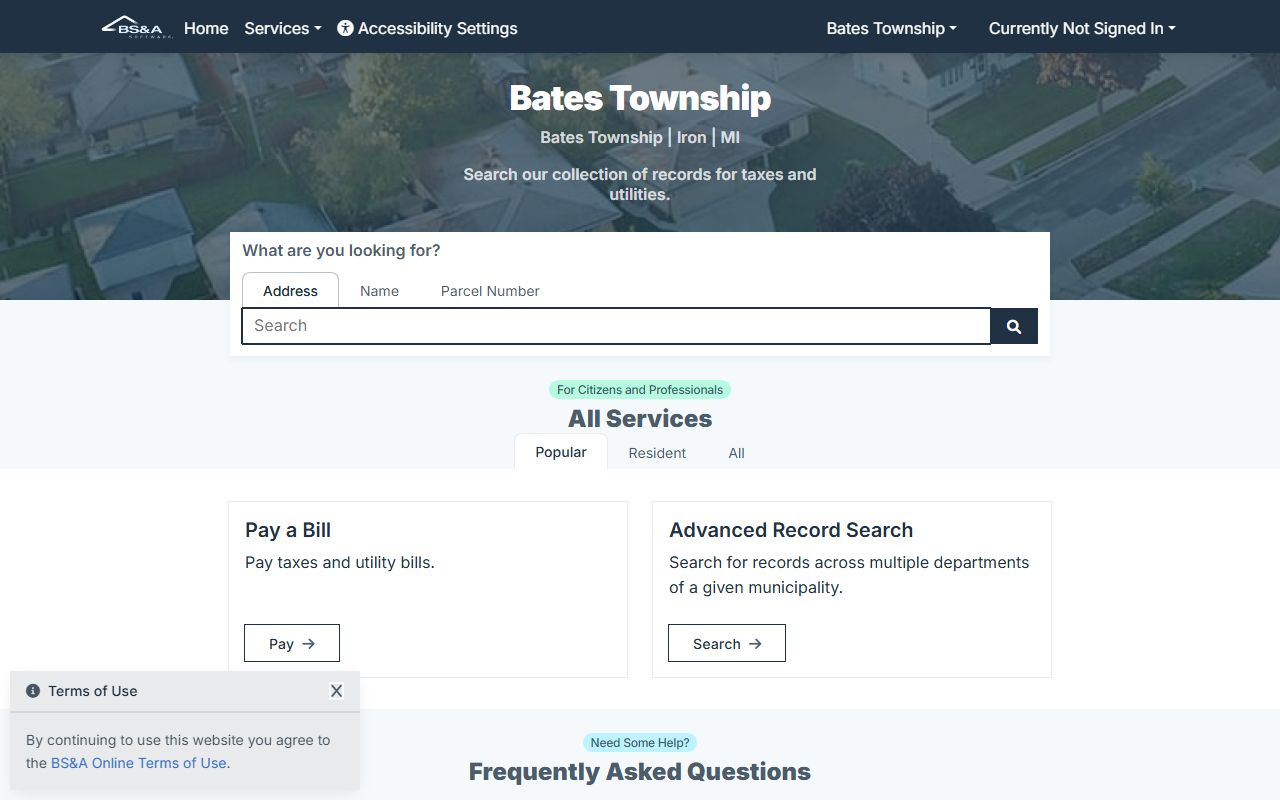
This portal is maintained by the county and reflects current assessment and tax year data for all parcels in Arenac County.
Arenac County Equalization Department
The Equalization Department runs the annual process of reviewing and certifying township property assessments. Director Gary Rennell oversees this work for Arenac County. Under MCL 211.1 et seq., all real and personal property in Michigan must be assessed at 50% of its true cash value. The equalization process compares township assessments against market data to make sure the county meets this standard. If a local unit is off, the county adjusts the equalized value.
The department also handles special assessments, reviews exemption applications, and maintains the county's parcel database. Arenac County is a smaller, rural county along Saginaw Bay. The property mix includes residential parcels near the water, farm and forest land in the interior townships, and some commercial property in Standish and Omer. All of this feeds into the equalization work done each year.
| Office | Arenac County Equalization Department |
|---|---|
| Director | Gary Rennell |
| Address | 120 N. Grove St., Standish, MI 48658 |
| Phone | 989-846-6188 |
| Online Search | BS&A Online - Arenac County |
Arenac County Register of Deeds
The Register of Deeds in Arenac County records all real estate documents, including deeds, mortgages, and liens. Register Kathleen H. Ostrander can be reached at 989-846-9201. When a property in Arenac County changes hands, the new owner must file a Property Transfer Affidavit (Form L-4025) with the local assessor within 45 days of the transfer. This document initiates the uncapping of taxable value required by Michigan law. Not filing on time results in a penalty under state statute.
Recorded documents are public records. Copies cost $1 per page, and certified copies are $5 each. The standard recording fee is $30 per document. If you are researching an Arenac County property and need to verify ownership or check for liens, the Register of Deeds is the place to look. This information pairs well with the tax records in the BS&A portal to give a full picture of a property's status.
Note: Confirm the current owner of record before relying on any online parcel data, as ownership changes may take time to appear in the database.
How Property Is Assessed in Arenac County
Arenac County assessors value property as of December 31 under MCL 211.30. The assessed value must equal 50% of the property's true cash value. The taxable value, which is used to calculate your bill, is capped and grows by the lesser of inflation or 5% per year as long as ownership does not change. When a property transfers, taxable value uncaps and resets to the assessed value the following year. For buyers in Arenac County, this means taxes can increase significantly in the first year of ownership.
Assessment notices go out in February. They show both the assessed and taxable values along with any exemptions applied. Arenac County has a variety of property types, including waterfront parcels along Saginaw Bay and the Rifle River, agricultural land in the townships, and residential neighborhoods in Standish. Assessors use different data sets to value each property type. The Equalization Department reviews all of these township figures each spring to ensure county-wide compliance with the 50% rule.
If you are buying property in Arenac County, the Michigan Property Tax Estimator can help you model what your tax bill will look like after closing. It factors in millage rates and assessed values to give you a projected number.
Property Tax Exemptions in Arenac County
The Principal Residence Exemption (PRE) is the main exemption available to Arenac County homeowners. Under MCL 211.7u, if your Arenac County property is your primary Michigan residence, you qualify to remove 18 mills from your school operating tax. File Form 2368 with your local assessor by June 1. This can save hundreds of dollars per year depending on your millage rate. Seasonal and vacation homes do not qualify, even if you own them outright.
Agricultural property in Arenac County may qualify for an exemption under MCL 211.7v. The county has farming and timber operations across several townships. If your land qualifies as agricultural property under state law, the exemption can reduce your tax burden significantly. Discuss eligibility with the Equalization Department to understand what documentation you need.
Low-income homeowners can apply for the Poverty Exemption by filing Form 5737 and Form 4988 with their township assessor before the March Board of Review. Disabled veterans and surviving spouses may qualify for additional exemptions. The Equalization Department can tell you which exemptions are available and how to apply for them in Arenac County.
Appealing an Arenac County Property Tax Assessment
Property owners in Arenac County can protest their assessed value at the March Board of Review. The Board meets each year in March to hear appeals from owners who believe their value is too high. You can appear in person or submit a written protest before the deadline. Bring comparable sales data, a recent appraisal, or other evidence showing what your property is actually worth. The Board will consider your evidence and issue a ruling.
If the Board of Review does not resolve your concern, you can appeal to the Michigan Tax Tribunal. The MTT handles property tax disputes statewide. The filing deadline is July 31 for residential property and May 31 for commercial. Call the MTT at 517-335-9760 for information on how to file. Your rights throughout this process are protected under the Property Taxpayer's Bill of Rights in MCL 205.735, which requires fair procedures and written explanations of decisions.
Arenac County Property Tax Payments
Local township treasurers collect property taxes during the tax year in Arenac County. Summer taxes are billed in July and due in September. Winter taxes come out in December and are typically due in February. Once taxes become delinquent, they move to the Arenac County Treasurer. County Treasurer Eugene L. Lutz can be reached at 989-846-6186 and handles delinquent balances, interest, and payment inquiries.
Michigan law imposes interest and fees on delinquent property taxes. Over time, unpaid taxes can lead to forfeiture and then foreclosure, with the county eventually taking the property. If you have outstanding taxes on an Arenac County parcel, call the Treasurer's office to get the current balance and learn what options you have. Addressing delinquency early is always the better path.
Communities in Arenac County
Arenac County includes the city of Standish (the county seat), as well as Omer, Au Gres, and several townships. None of these communities meet the population threshold for individual city pages. Property tax records for all areas in Arenac County can be searched through the BS&A Online portal linked above.
Nearby Counties
Arenac County is bordered by several other Michigan counties. Each has its own equalization office and tax record system.