
Bay County Property Tax Records
Bay County property tax records are managed by the County Equalization Department at 515 Center Ave. in Bay City. The county uses the BS&A Online platform for public parcel searches and also provides a GIS mapping system through the county website. Both tools let you search assessed values, tax history, and parcel details for properties across Bay County. This guide walks through how to use those tools, how assessments work in Bay County, what exemptions may reduce your tax bill, and how to appeal if you disagree with your property's value.
Bay County Overview
How to Search Bay County Property Tax Records
Bay County gives the public two online tools to search property tax records. The primary option is the Bay County BS&A Online portal. You can search by owner name, parcel number, or property address. The portal shows the current assessed value, taxable value, legal description, and tax history. It covers every parcel in Bay County, including the city of Bay City, all townships, and the smaller cities of Essexville and Pinconning.
Bay County also maintains a GIS system through the county website at baycounty-mi.gov/gis/. This tool lets you look up parcels visually on a map. Click on any parcel to see its data, which can help when you know the location of a property but do not have a parcel number or owner name. Both the BS&A portal and the GIS map are free and available without an account.
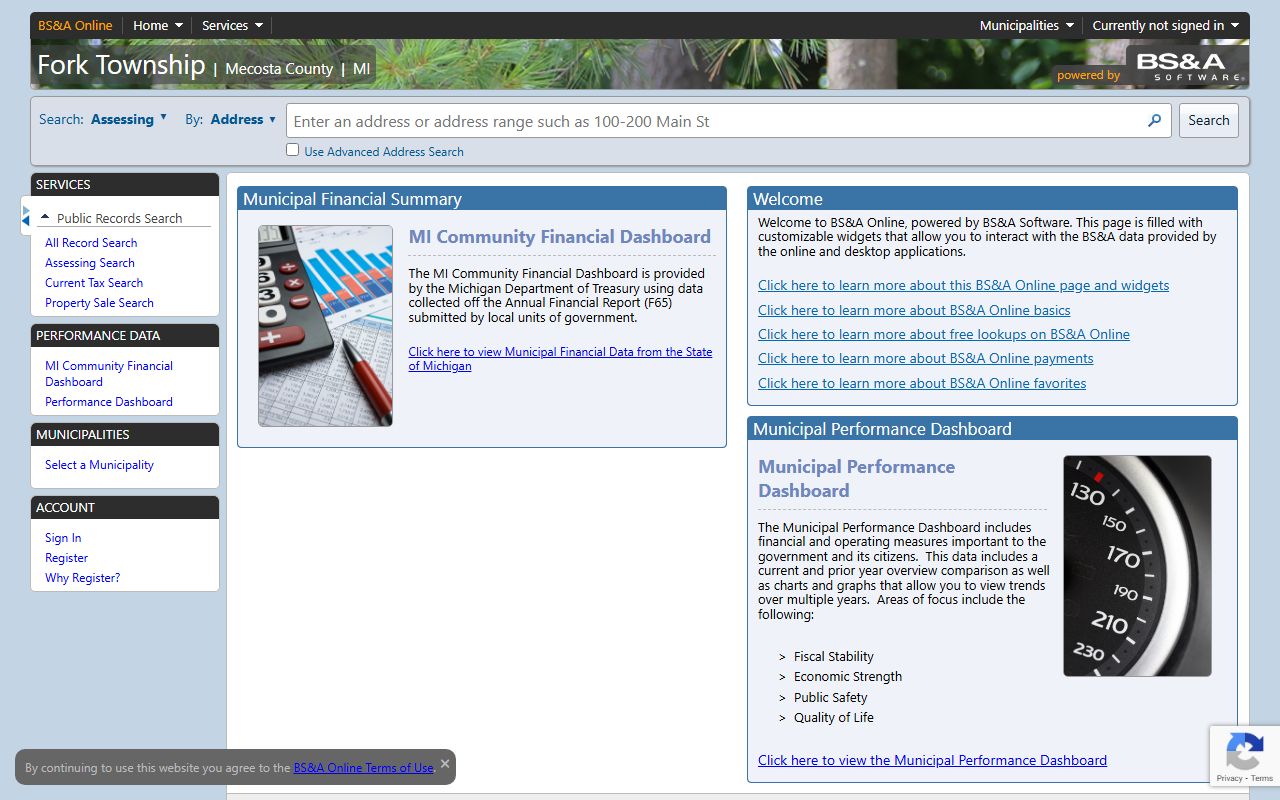
The screenshot below shows the BS&A Online portal that Bay County uses for public property tax record searches.
For questions about specific parcels or records not shown online, contact the Equalization Department at 515 Center Ave. in Bay City, or call Director James R. Kephart's office at 989-895-4045.
Bay County Equalization Department
Director James R. Kephart leads the Bay County Equalization Department at the Bay County Building in downtown Bay City. The department reviews all local unit assessments and certifies the county equalized value each spring. Michigan law under MCL 211.1 et seq. requires that property be assessed at 50% of its true cash value. The Equalization Department checks whether township and city assessors are hitting this mark. Where they are not, the county adjusts the equalized value to bring it into line.
Bay County is a mid-sized county with a mix of urban property in Bay City, suburban residential development in the townships, agricultural land in the outlying areas, and industrial sites near the Saginaw River and Saginaw Bay. Assessing this variety requires different methods for different property classes. The department uses current sales data and cost approaches to arrive at equalized values for each class. Staff is available during business hours to answer questions about valuations and the equalization process.
| Office | Bay County Equalization Department |
|---|---|
| Director | James R. Kephart |
| Address | 515 Center Ave., Bay City, MI 48708 |
| Phone | 989-895-4045 |
| GIS Map | Bay County GIS |
| Online Search | BS&A Online - Bay County |
Bay County Register of Deeds
The Register of Deeds records all real property transactions in Bay County, including deeds, mortgages, liens, and land contracts. Register Brandon A. Krause manages this office at 989-895-4228. When a Bay County property sells or transfers, the buyer must file a Property Transfer Affidavit (Form L-4025) with the local assessor within 45 days of the transfer date. This filing triggers the uncapping of taxable value, which raises the taxable value to the assessed value in the following tax year. Not filing on time results in penalties under Michigan law.
Documents recorded at the Register of Deeds are public records. Copies cost $1 per page and certified copies are $5. The standard recording fee is $30 per document. These records are useful when researching ownership history, checking for encumbrances, or tracing how a Bay County property's ownership has changed over the years. Use the BS&A portal alongside Register of Deeds records for a complete picture of any parcel.
Note: Recorded documents typically appear in the public index within a few business days of recording, though delays can occur during high-volume periods.
How Bay County Property Assessments Work
Bay County assessors value property as of December 31 each year, which is Michigan's Tax Day under MCL 211.30. The assessed value must equal 50% of the property's true cash value. Taxable value is a separate figure used for calculating your actual bill. It can only grow by the lesser of the inflation rate or 5% per year, as long as ownership stays the same. When a sale occurs, taxable value uncaps and resets to the assessed value the following January. For many buyers in Bay County, this reset means their first-year tax bill is notably higher than what the prior owner paid.
Assessment notices go out in February. The notice shows your assessed value, taxable value, and any active exemptions. If you disagree with the values on your notice, the March Board of Review is your first opportunity to act. Bay County covers a range of property types. Bay City and the nearby cities have significant commercial and industrial property, while the outlying townships are more residential and agricultural. Each class of property follows its own assessment approach under Michigan law.
The Michigan Property Tax Estimator is a helpful tool if you want to estimate what taxes will be on a Bay County property before buying. Enter the assessed value and millage rate to get a projected tax amount. More detail on how the statewide system works is available on the Michigan Treasury property tax page.
Property Tax Exemptions in Bay County
The Principal Residence Exemption (PRE) is the biggest tax break available to most Bay County homeowners. Under MCL 211.7u, owners who use their property as their primary Michigan residence can remove 18 mills from the school operating tax. File Form 2368 with your local city or township assessor by June 1. Bay City residents file with the city assessor; township residents file with their township assessor. The exemption only covers your main home, not rental units or cottages.
Agricultural property in Bay County's rural townships may qualify for the agricultural exemption under MCL 211.7v. Eligible farmland can carry a lower effective tax rate than general residential or commercial property. The Equalization Department can review your parcel to help you determine if it qualifies under the agricultural classification standards.
The Poverty Exemption reduces or eliminates property taxes for low-income homeowners. File Form 5737 and Form 4988 with your local assessor before the March Board of Review. Disabled veterans and surviving spouses have separate exemption options. Contact the Bay County Equalization Department or your local assessor to discuss which exemptions may apply to you.
Appealing a Bay County Property Tax Assessment
If your Bay County assessed value seems too high, you can protest at the March Board of Review. The Board meets in March each year and accepts both in-person appearances and written protests filed before the session ends. Gather evidence before you go: a recent appraisal, your purchase price if you bought recently, or recent sales of comparable properties in your area. The Board considers your evidence and can lower the assessment if it finds the current value is too high.
If the Board of Review does not resolve the issue, your next step is the Michigan Tax Tribunal. This independent state body handles property tax disputes. The filing deadline is July 31 for residential property and May 31 for commercial property. Call the MTT at 517-335-9760 for instructions on how to file. Your rights during this process are laid out in the Property Taxpayer's Bill of Rights under MCL 205.735, which requires clear written decisions and a fair process at every step.
Bay County Property Tax Payments
City and township treasurers in Bay County collect taxes during the current tax year. Summer taxes are billed in July and usually due in September. Winter taxes go out in December and are typically due in February, though specific due dates vary by local unit. Once taxes become delinquent, they transfer to the Bay County Treasurer. Treasurer Paul A. Mender handles delinquent collections and can be reached at 989-895-4030.
Delinquent property taxes accrue interest under Michigan law. Unpaid taxes eventually lead to forfeiture and can result in foreclosure if not resolved. The county takes ownership of foreclosed properties and sells them at annual tax sales. If you have overdue taxes on a Bay County property, contact the Treasurer's office immediately to get the current balance and explore payment options. Acting quickly limits the amount you owe and protects your property from further action.
Communities in Bay County
Bay County includes the city of Bay City, along with the cities of Essexville and Pinconning, and numerous townships such as Bay, Bangor, Fraser, Hampton, Kawkawlin, Merritt, Monitor, Pinconning, Portsmouth, and Williams. None of these communities other than Bay City meet the population threshold for individual city pages. All Bay County property tax records can be searched through the BS&A Online portal and the county GIS system.
Nearby Counties
These counties border Bay County in central Michigan. Each manages property tax records through its own equalization office.