
Delta County Property Tax Records
Delta County property tax records are managed by the Equalization Department in Escanaba. These records cover all assessed parcels in the county, including residential, commercial, agricultural, and industrial land. You can search Delta County property tax records online through the BS&A portal or visit the office in person to get assessment details, tax history, and parcel data for any property in the county.
Delta County Overview
Delta County Equalization Department
The Equalization Department is the main office for Delta County property tax records. Director Sandy A. Swanson leads the office, which is responsible for reviewing and equalizing assessed values across all local townships and the city of Escanaba. The department sets the equalized value for each parcel and maintains the county's master property records. Under MCL 211.1, all real property in Michigan is subject to taxation, and the equalization process ensures values are uniform across the county.
Assessment notices go out each February, showing the taxable value and state equalized value for your property. If you think your assessment is wrong, you have a short window to act. The March Board of Review is where you bring your case first. After that, you can appeal to the Michigan Tax Tribunal. The office staff can walk you through what records are on file and how the assessment was set. They keep parcel data, land records, and prior year assessments on file for public review.
| Department | Delta County Equalization |
|---|---|
| Director | Sandy A. Swanson |
| Address | 310 Ludington St., Escanaba, MI 49829 |
| Phone | 906-789-5110 |
Search Delta County Property Tax Records Online
Delta County uses the BS&A Online platform for public property tax record access. You can look up parcels by owner name, address, or parcel number. The system shows current and prior year assessed values, taxable values, and tax bill amounts. It also shows land and building breakdowns for most parcels.
The BS&A portal for Delta County is a good starting point for any property research. You can find ownership history, lot size, and structure details without visiting the office. The portal pulls live data directly from the county's assessment records, so the information is current. Some older historical records may only be available in person at the Equalization office.
The county also maintains a GIS mapping system that overlays parcel data on aerial imagery. This tool is useful if you need to identify parcel boundaries, check neighboring lots, or confirm a property's location. The two systems work together to give a full picture of any parcel in Delta County.
The Delta County Equalization Department's BS&A property search portal gives public access to parcel records and assessed values for all parcels in the county. The screenshot below shows the search interface at bsaonline.com.
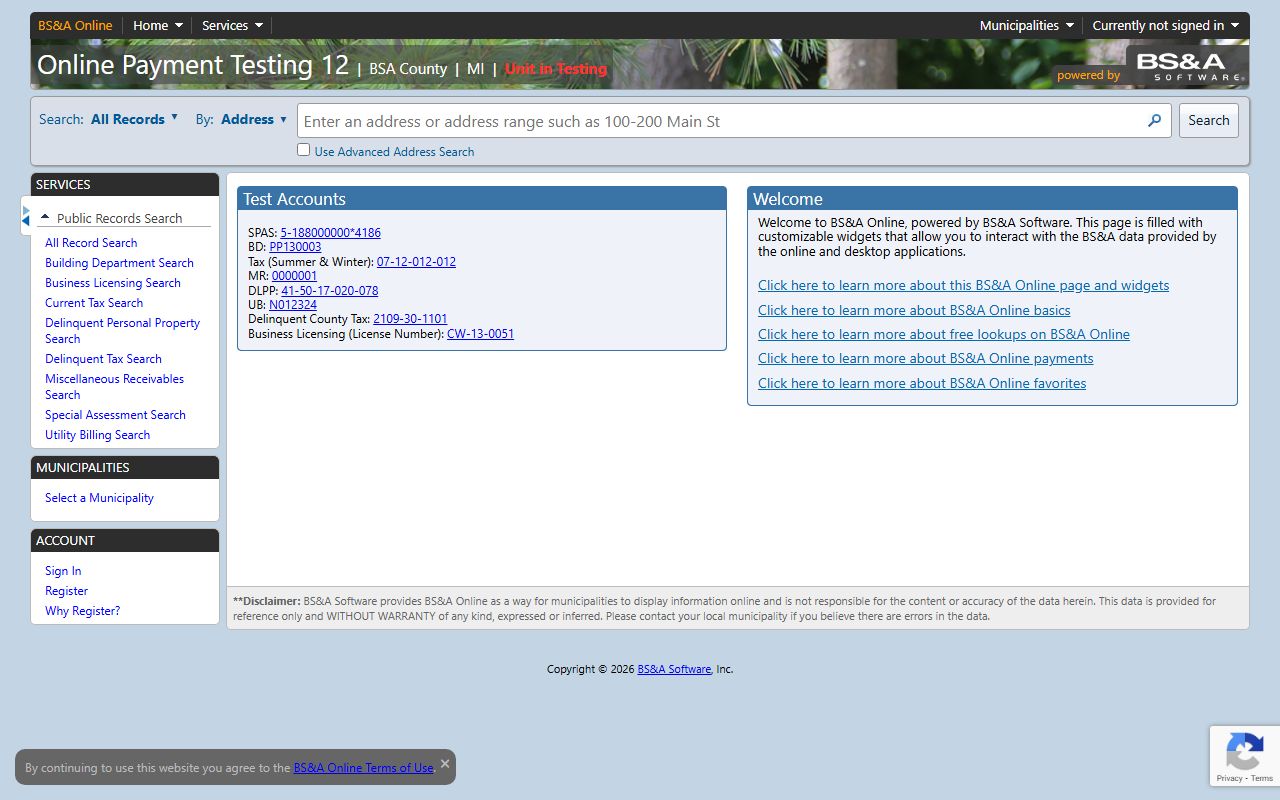
The BS&A portal is free to use and requires no login for basic parcel lookups. You can print or save results for your records.
Delta County's GIS mapping system provides an interactive map of all parcels, showing boundaries, land use, and parcel identifiers. The screenshot below is from the Delta County GIS portal.

Use the GIS map to locate a parcel visually, then cross-reference with the BS&A portal to pull the full tax record.
Delta County Treasurer
The Delta County Treasurer handles property tax collection and delinquent tax records. Treasurer Robin L. Cappaert can be reached at 906-789-5105. Summer taxes are billed by local townships and the city of Escanaba. Winter taxes follow later in the year. If taxes go unpaid, the county treasurer takes over the collection process, and the parcel can eventually become tax-forfeited.
Delinquent property tax records are public. The treasurer's office keeps a record of all parcels with unpaid taxes, including the amounts owed and the year each became delinquent. These records are separate from the equalization records but are often used together when researching a property. You can ask the treasurer's office for a tax status report on any parcel in Delta County.
Note: Late property taxes in Michigan accrue interest at a set rate. Contact the Delta County Treasurer's office directly for current delinquency rates and redemption deadlines.
Delta County Register of Deeds
The Register of Deeds office maintains all land records that affect property ownership in Delta County. Register Gayle R. VanDam can be reached at 906-789-5116. This office records deeds, mortgages, liens, and other documents that establish or change ownership. When you research a property's tax history, you often need to cross-reference deeds to confirm who owns the parcel and when ownership changed.
Recording fees in Michigan are set at $30 per document under standard state rates. Copies of recorded documents cost $1 per page, and certified copies cost $5. The Register of Deeds office at 310 Ludington St. in Escanaba handles all recording and copy requests for Delta County land records. When a property is sold, the buyer has 45 days to file a Property Transfer Affidavit using Form L-4025 to notify the assessing office of the change in ownership.
Under MCL 211.30, assessors use December 31 of the prior year as Tax Day, meaning the status of a property on that date determines how it is assessed for the coming year. Ownership changes recorded after December 31 affect the next assessment cycle.
Exemptions and Appeals in Delta County
Michigan offers several property tax exemptions that Delta County property owners can apply for. The most common is the Principal Residence Exemption, which exempts your home from up to 18 mills of local school operating taxes. To qualify, the property must be your primary residence on December 31. File Form 2368 with your local assessor. The PRE is governed by MCL 211.7u and can result in meaningful savings each year.
Agricultural property may qualify for a separate exemption under MCL 211.7v if it meets the state's definition of qualified agricultural property. Delta County has a mix of farmland and forested land, and some parcels may be eligible for both the agricultural exemption and other special classifications. Talk to the Equalization Department to find out what applies to your parcel.
If you disagree with your assessment, your first step is the March Board of Review. You must appear or submit a written protest during the Board's session. If that does not resolve the issue, you can file a petition with the Michigan Tax Tribunal at 517-335-9760. Residential appeals must be filed by July 31. Commercial and industrial appeals must be filed by May 31. The Taxpayer's Bill of Rights under MCL 205.735 gives you the right to challenge your assessment and be heard.
Poverty exemptions are also available for qualifying homeowners. You file Form 5737 and Form 4988 with the assessor's office. Income and asset limits apply, and the exemption is reviewed each year. The Michigan Department of Treasury's property tax page has more details on all available exemptions and how to apply for them.
Michigan Property Tax Resources
Delta County property owners can use several state-level tools in addition to local resources. The Michigan Department of Treasury offers a property tax estimator that lets you project your bill based on assessed value and local millage rates. This is a good tool for budgeting or comparing properties before you buy.
The state's main property tax information page covers assessment rules, exemption forms, and appeal procedures that apply across all Michigan counties including Delta. If you are dealing with a complex tax issue, consulting a licensed Michigan tax professional or contacting the Michigan Tax Tribunal directly may be your best path forward.
Nearby Counties
Delta County shares borders with several Upper Peninsula counties. Each has its own equalization office and property tax records system.