
Search Grand Traverse County Property Tax Records
Grand Traverse County property tax records are available through BS&A Online and the county GIS mapping system, both maintained by the Equalization Department in Traverse City. Parcel owners, buyers, and researchers can search assessed values, taxable values, and tax payment history for properties throughout the county. The Equalization Department at 400 Boardman Ave. oversees annual assessments for all townships and cities in Grand Traverse County. This page covers the search tools, local offices, exemptions, and appeal procedures you need.
Grand Traverse County Overview
How to Search Grand Traverse County Property Tax Records
Grand Traverse County offers two main tools for searching property tax records online. The first is the Grand Traverse County BS&A property search, which lets you search by owner name, address, or parcel number. Results include assessed value, taxable value, tax amounts, and payment history. The second tool is the Grand Traverse County GIS system, which links parcel data to aerial imagery and mapping layers. Both are free and require no account to use.
For most searches, the BS&A portal is the fastest option. The GIS tool is useful when you want to see a parcel's location relative to roads, water, or neighboring parcels. Grand Traverse County's GIS is well maintained and covers the full county, making it one of the more capable county-level mapping tools in northern Michigan. If you need to identify a parcel by its physical location rather than an address, start with the GIS map and then confirm the tax details in BS&A.
The two screenshots below show the BS&A portal and the GIS mapping system used to access Grand Traverse County property tax records.
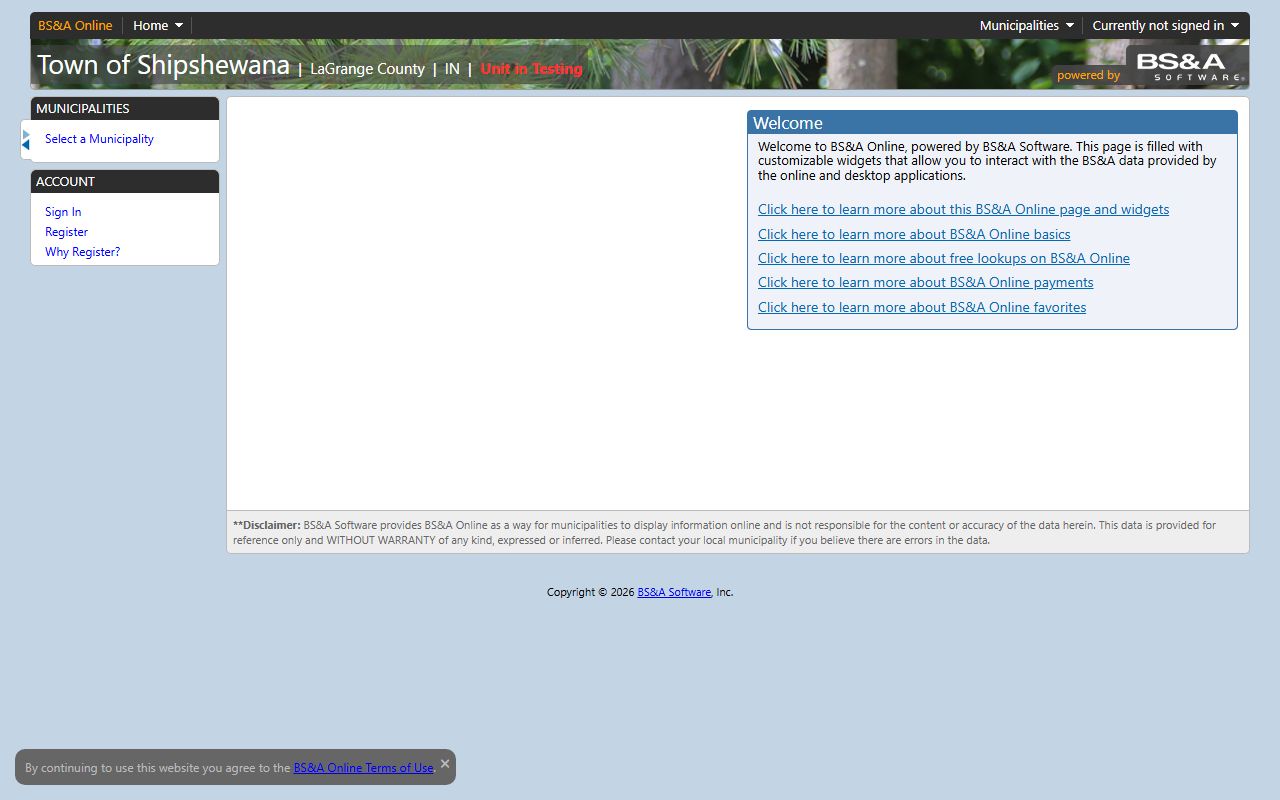
The BS&A portal shows current assessment data, tax amounts, and payment history for Grand Traverse County parcels.
The GIS mapping system provides a visual view of parcels in Grand Traverse County and links to full property tax record details.
Grand Traverse County Equalization Department
The Equalization Department in Grand Traverse County reviews and equalizes property assessments across all local units. Director Michael R. Williams leads the department from the County Government Center at 400 Boardman Ave. in Traverse City. Under MCL 211.1 et seq., all taxable property in Michigan must be assessed at 50% of its true cash value. The department checks each township's rolls annually and certifies them to the state after confirming they meet this standard.
Staff can assist with parcel lookups, exemption applications, and questions about how specific properties were valued. The department manages both the BS&A portal data and works closely with the county GIS office. Most records are public. Call 231-995-6010 to ask about hours, what records are available in person, or for help finding a specific parcel that does not appear in the online system.
| Office | Grand Traverse County Equalization Department |
|---|---|
| Director | Michael R. Williams |
| Address | 400 Boardman Ave., Traverse City, MI 49684 |
| Phone | 231-995-6010 |
| Online Search | BS&A Online - Grand Traverse County |
| GIS Mapping | Grand Traverse County GIS |
Grand Traverse County Register of Deeds
The Register of Deeds records all real estate instruments in Grand Traverse County. That covers deeds, mortgages, liens, easements, and related documents that affect property title. When any property changes hands, the new owner must file a Property Transfer Affidavit (Form L-4025) with the local assessor within 45 days of the sale. This is a Michigan law requirement. It starts the uncapping process so that the taxable value resets to the assessed value in the next tax year.
Register Peggy A. Haines oversees the office at 400 Boardman Ave. in Traverse City, the same building as the Equalization Department. The county's Register of Deeds can be reached at 231-995-6070. Document searches are available through the Grand Traverse County Register of Deeds website. Recording fees follow the standard Michigan rate of $30 per document. Copies are $1 per page and certified copies cost $5.
Note: Searching the Register of Deeds alongside the BS&A portal gives you both the ownership chain and the current tax status for any parcel in Grand Traverse County.
Property Tax Assessment in Grand Traverse County
Property in Grand Traverse County is assessed as of December 31 each year, which is Tax Day in Michigan under MCL 211.30. Each township and city assessor values parcels within their jurisdiction. The county Equalization Department then reviews those values to make sure they meet the required 50% of true cash value. Assessment notices are mailed to property owners each February.
Grand Traverse County has a broad range of property types. Lakefront parcels on Grand Traverse Bay and the many inland lakes carry some of the highest assessed values in the region. Commercial and mixed-use development in and around Traverse City adds another layer of complexity to the county's tax base. Rural and agricultural parcels in the outer townships tend to carry lower values but may still see significant assessment increases during active real estate markets.
Taxable value is capped at the rate of inflation or 5%, whichever is less, as long as ownership does not change. After a sale, taxable value uncaps the following year and resets to the assessed value. For properties with long ownership histories, this can mean a major jump. Buyers in Grand Traverse County should use the Michigan Property Tax Estimator before completing a purchase. The Michigan Treasury provides guidance on assessment rules for the full state.
Property Tax Exemptions in Grand Traverse County
Several exemptions can reduce property taxes for qualifying Grand Traverse County owners. The Principal Residence Exemption (PRE) is the most widely used. Under MCL 211.7u, homeowners who use the property as their primary residence can remove 18 mills from the school operating tax. File Form 2368 with the local township assessor by June 1. Vacation or seasonal properties do not qualify because they are not primary residences.
Agricultural property may qualify under MCL 211.7v if the land and operations meet the statutory definition. Grand Traverse County has cherry orchards, vineyards, and other farm operations in the outer townships that may be eligible. The Poverty Exemption is available for low-income homeowners who meet income and asset requirements set by their local township. Forms 5737 and 4988 must be filed with the township assessor, and the March Board of Review makes decisions on applications each year. Disabled veterans and surviving spouses may also qualify for full or partial exemptions under Michigan law. Call the Equalization Department at 231-995-6010 for guidance on any of these programs.
Appealing Your Grand Traverse County Assessment
If you think your Grand Traverse County property is over-assessed, the first step is the March Board of Review in your local township or city. You can appear in person or file a written protest before the township's deadline. Bring documentation supporting a lower value. In Grand Traverse County's active real estate market, recent comparable sales carry the most weight as evidence. The Board of Review can reduce your assessment or leave it as is.
If the Board does not fix the problem, file with the Michigan Tax Tribunal. The MTT hears appeals statewide. For residential property, the filing deadline is July 31. For commercial property it is May 31. The Tribunal can be reached at 517-335-9760. Your rights throughout the process are outlined in the Property Taxpayer's Bill of Rights under MCL 205.735. Given how fast values have moved in the Traverse City area, an independent appraisal is often worth the cost before filing a formal appeal.
Grand Traverse County Property Tax Payments
Summer taxes in Grand Traverse County are typically billed in July and due in September. Winter taxes are billed in December and due in February. These dates can vary slightly by township. Check with your local township treasurer to confirm the exact due dates for your parcel. Once taxes go past due at the township level, they are forwarded to the Grand Traverse County Treasurer.
Treasurer Vicky L. VanBuren's office handles delinquent property taxes, payment arrangements, and forfeiture proceedings. Call 231-995-6080 for help with a delinquent balance or to discuss payment options. Michigan law causes delinquent taxes to grow with interest and fees the longer they go unpaid. Properties that remain delinquent for three years enter the county forfeiture process and can ultimately be lost through foreclosure. Paying or setting up a plan as soon as possible limits the total cost and protects ownership.
Note: Online payment options for current taxes are typically available through the local township treasurer's office or the BS&A portal, depending on the township.
Cities in Grand Traverse County
Grand Traverse County includes Traverse City, the county seat and the region's main city, along with Fife Lake, Kingsley, and several townships including Acme, Blair, East Bay, Garfield, Grant, Green Lake, Long Lake, Paradise, Peninsula, and Union. None of the municipalities in Grand Traverse County meet the population threshold for individual city pages on this site. Property tax records for all communities are available through the county Equalization Department and the BS&A and GIS portals.
Nearby Counties
These counties are near Grand Traverse County in northern Michigan. Each has its own equalization office and property search system. Check which county a parcel is in before running a search, especially for properties near county lines.