
Search Leelanau County Property Tax Records
Leelanau County property tax records are managed by the Equalization Department at 8527 E. Government Center Dr. in Suttons Bay. The county uses the BS&A Online platform to provide public access to parcel data, assessed values, taxable values, and tax history for all townships in the county. Leelanau is a peninsula county with a mix of rural, agricultural, and waterfront properties, and this guide explains how to access property tax records, what the equalization process involves, and what options you have if you disagree with your assessment.
Leelanau County Overview
How to Search Leelanau County Property Tax Records
The primary online tool for Leelanau County property tax records is the Leelanau County BS&A Online property search portal. You can search by owner name, property address, or parcel number. The portal returns current owner information, legal description, assessed value, taxable value, and tax history for each parcel. All townships in Leelanau County are covered, including those with seasonal and waterfront properties that tend to have higher assessed values.
The search is free and open to the public. No registration is required. If you are searching a rural parcel with a non-standard address, try the parcel number first since address formats can vary. Parcel numbers appear on your assessment notice and on tax bills. For GIS mapping and parcel boundary information, visit the Leelanau County equalization page, which links to county mapping resources.
In-person help is available at the Equalization Department, 8527 E. Government Center Dr. in Suttons Bay. Director Joe S. Soffredine's office can be reached at 231-256-9835. Call ahead before visiting since office hours in smaller counties can vary, especially outside of tax season.
The screenshot below shows the BS&A Online portal used for Leelanau County property tax record searches. This is the main public access point for parcel and assessment data in the county.
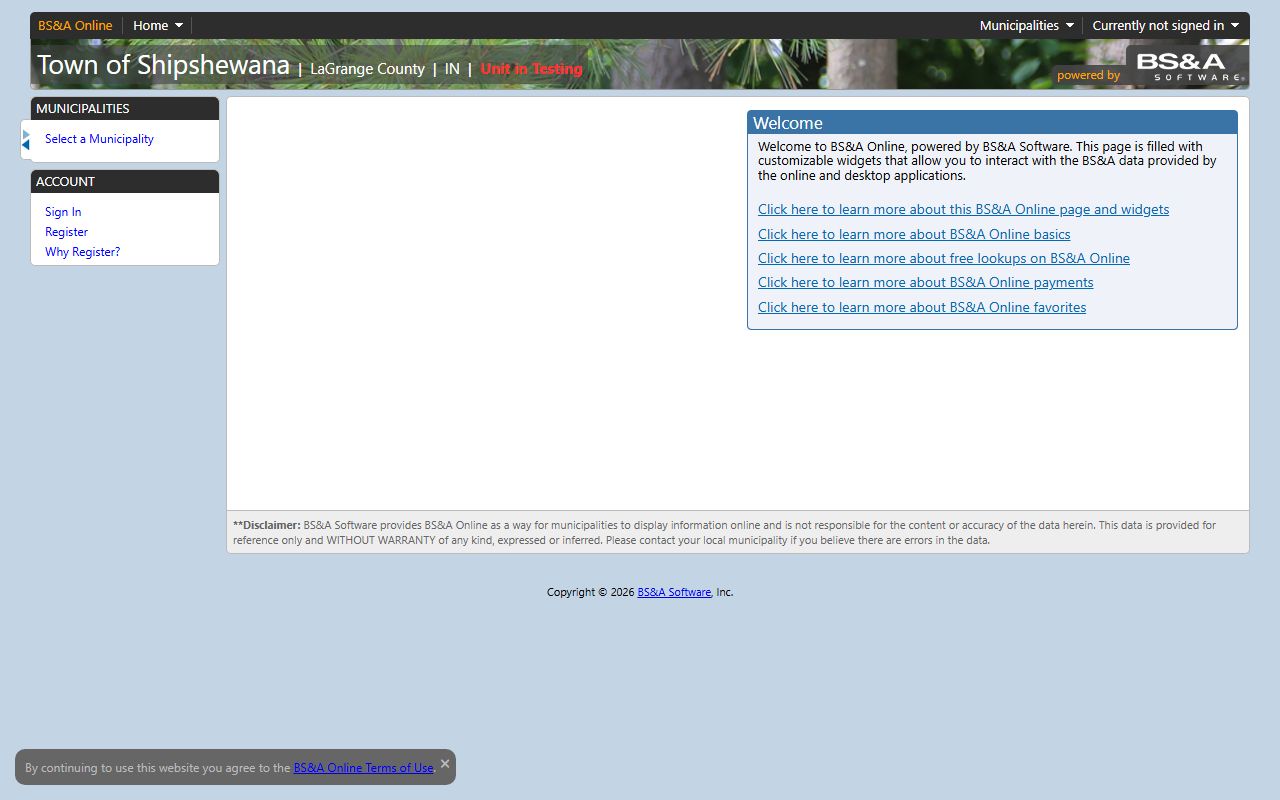
Data in the portal is updated by the county. If values appear stale or do not match your assessment notice, contact the Equalization Department to verify.
Leelanau County Equalization Department
The Equalization Department reviews and equalizes township assessments each year in Leelanau County. Under MCL 211.1 et seq., all property in Michigan must be assessed at 50% of its true cash value. Director Joe S. Soffredine and the Equalization staff review assessments set by individual township assessors and apply equalization factors where the county's townships fall above or below the state standard. Leelanau County's real estate market includes a mix of inland, agricultural, and high-value waterfront parcels, which can create complexity in the equalization process.
The department maintains property data for the county, processes exemption applications, and manages special assessment rolls. Records are public and accessible during regular business hours. The BS&A Online portal makes many records available without a visit, but in-person review may be needed for older records or complex parcel situations. The equalization page at leelanau.gov provides contact information and links to additional county resources.
| Office | Leelanau County Equalization Department |
|---|---|
| Director | Joe S. Soffredine |
| Address | 8527 E. Government Center Dr., Suttons Bay, MI 49682 |
| Phone | 231-256-9835 |
| Online Search | BS&A Online - Leelanau County |
| GIS / Mapping | Leelanau County Equalization |
Leelanau County Register of Deeds
The Register of Deeds records all instruments that affect real property in Leelanau County. Deeds, mortgages, liens, discharges, and easements are filed here and maintained as public records. Register Susan L. Graham oversees the office at 8527 E. Government Center Dr. in Suttons Bay. Reach the Register of Deeds at 231-256-9830 for document requests, recording questions, or copies of instruments on file for a specific parcel.
When property changes hands in Leelanau County, the new owner must file a Property Transfer Affidavit (Form L-4025) with the local township assessor within 45 days of the transfer. This form is required under Michigan law and triggers the uncapping of the taxable value, resetting it to the full assessed value in the next tax year. Buyers who do not file on time can face complications with their assessment and any exemptions they plan to claim. The standard Michigan recording fee is $30 per document. Copies cost $1 per page, and certified copies are $5.
Note: Waterfront and vacation properties are common in Leelanau County. Buyers of seasonal or second homes should understand that the Principal Residence Exemption does not apply unless the property is your true primary residence.
Property Tax Assessment in Leelanau County
Michigan sets Tax Day as December 31 of each year under MCL 211.30. Township assessors in Leelanau County value each parcel as of that date, and the Equalization Department reviews those values each spring. Assessment notices arrive in February and show both the assessed value (which should be 50% of true cash value) and the taxable value (which is used to calculate the actual tax bill). In Leelanau County, where waterfront properties can carry high market values, the gap between assessed and taxable value can be substantial for long-term owners.
Michigan's taxable value cap limits increases to the lesser of the inflation rate or 5% per year. Long-term owners benefit from this cap because their taxable value can grow far slower than market values. When a property sells, though, the taxable value uncaps and resets to the full assessed value in the following tax year. For buyers of higher-priced Leelanau County properties, particularly lakefront parcels, this can mean a very large jump in annual taxes after purchase. The Michigan Property Tax Estimator is a useful tool for modeling what taxes will look like after a transfer.
Millage rates in Leelanau County vary by township and school district. The Michigan Treasury explains how millage rates combine with assessed values to produce the final tax bill. Your actual tax rate depends on where your parcel sits and which local units levy taxes against it.
Property Tax Exemptions in Leelanau County
The Principal Residence Exemption is available to Leelanau County homeowners who occupy their property as a primary home. Under MCL 211.7u, the PRE removes 18 mills from the school operating tax. File Form 2368 with your local township assessor by June 1 to claim this exemption. Because Leelanau County has a large number of vacation and seasonal properties, the distinction between a primary home and a second home matters. The PRE only applies to the property where you actually live most of the year.
Agricultural land in Leelanau County, including vineyards and orchards that are common in this area, may qualify for an exemption under MCL 211.7v. The property must meet the state's definition of agricultural use. Contact your township assessor or the Equalization Department to determine whether your operation qualifies and to get the appropriate forms. The Poverty Exemption is also available for low-income homeowners who file Form 5737 and Form 4988 with their township assessor before the March Board of Review. Disabled veterans and qualifying surviving spouses may also be eligible for relief under Michigan law.
Appealing Your Leelanau County Assessment
Property owners in Leelanau County who disagree with their assessment have the right to appeal. The first step is the March Board of Review in your township, which meets each March to hear protests. You can appear in person or submit a written protest before the township's deadline. The stronger your evidence, the better your chances. A recent independent appraisal is typically the most persuasive document you can bring. Comparable sales from similar properties in the same area also carry weight with most Boards of Review.
If the Board of Review does not resolve the issue, you can file a petition with the Michigan Tax Tribunal. The MTT is a state-level body that handles property tax appeals independently of the county. Residential property petitions are due by July 31. Commercial property petitions must be filed by May 31. The MTT is reachable at 517-335-9760. Your rights at each stage of the appeal process are outlined in the Property Taxpayer's Bill of Rights under MCL 205.735.
Leelanau County Property Tax Payments
Property taxes in Leelanau County are collected first at the local level by township treasurers. Summer taxes are generally due in September, and winter taxes come due in February. Your township treasurer sets the specific collection dates and handles your payments during those periods. If you are unsure who your township treasurer is, the Equalization Department can point you in the right direction.
After the local collection period ends, unpaid taxes become delinquent and are forwarded to the Leelanau County Treasurer. Treasurer John R. Agema's office handles delinquent collections, payment plans, and properties in the forfeiture process. Reach the Treasurer's office at 231-256-9824. Michigan law sets a timeline for forfeiture and foreclosure on properties with unpaid delinquent taxes. Addressing delinquent taxes early reduces the fees and interest that accumulate and avoids the risk of losing the property.
Note: Owners of seasonal or vacation properties who are not Michigan residents should make sure their tax bills are being forwarded to a current mailing address, as missed notices are not a defense against delinquency.
Cities in Leelanau County
Leelanau County is a rural peninsula county. Suttons Bay serves as the county seat. Other communities include Leland, Lake Leelanau, Cedar, and Glen Arbor. None of these municipalities meet the population threshold for individual city pages. Property tax records for all communities in Leelanau County are handled through the county Equalization Department and the BS&A Online portal.
Nearby Counties
Leelanau County is a peninsula county and shares borders with a limited number of neighboring counties. Check parcel boundaries carefully for properties near county lines.