
Property Tax Records in Otsego County
Otsego County property tax records are maintained by the County Equalization Department and the Register of Deeds in Gaylord. The county offers both online and in-person access to property data, assessed values, and recorded real estate documents. The Register of Deeds has maintained digital images going back to 1864, and electronic recording is available for document submissions. This guide walks through how to find Otsego County property tax records and who to contact for assessment and deed-related questions.
Otsego County Overview
How to Search Otsego County Property Tax Records
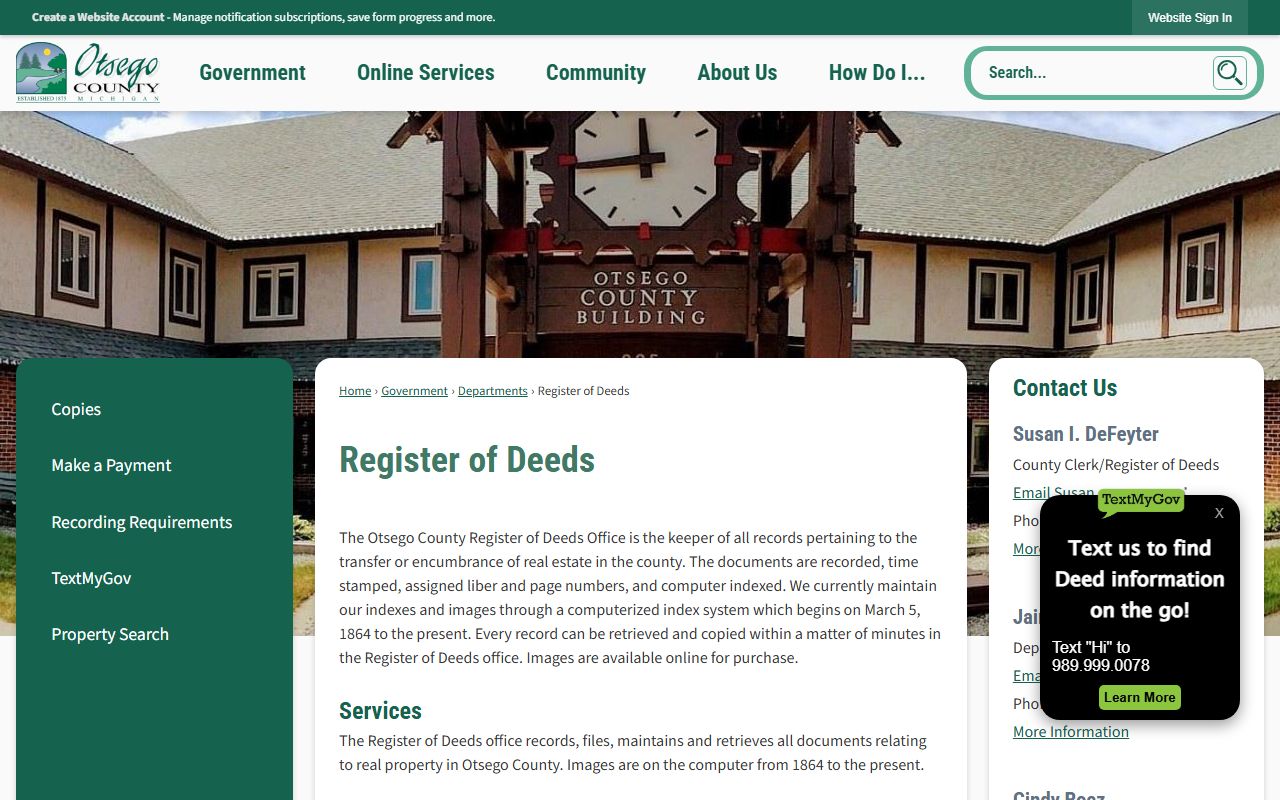
Otsego County property tax and assessment records can be searched through the county's online tools and the Register of Deeds portal. The Register of Deeds website at otsegocountymi.gov/259/Register-of-Deeds provides access to recorded documents with images available from 1864 to the present. This is one of the longer digital record histories available for a Michigan county. Electronic recording is accepted, which allows attorneys and title companies to submit documents without visiting the office in person.
The screenshot below shows the Otsego County Equalization and BS&A property tax search portal. This is your starting point for searching Otsego County property tax records online.
The portal covers property data for all Otsego County townships. For assessment lookups, parcel data, and value questions, the Equalization Department in Gaylord is the primary contact. The Michigan Treasury also maintains statewide tools for property tax research that can supplement local county resources. In-person visits to the courthouse in Gaylord are an option for records not fully available online.
Otsego County Equalization Department
The Equalization Department is responsible for property assessment oversight across all of Otsego County. Under MCL 211.1 et seq., all Michigan property must be assessed at 50% of its true cash value. The Equalization Department reviews township assessments each year and adjusts them to ensure the county meets that standard. Otsego County has a range of property types, from residential in and around Gaylord to rural, recreational, and forested parcels throughout the townships. All of these go through the same annual equalization process.
The department also handles special assessment rolls, exemption reviews, and maintains county property data. Most records are public and can be viewed during regular business hours at the courthouse or through online tools. For questions about a specific parcel's value or assessment history, the Equalization Department is the right place to start.
| Office | Otsego County Equalization Department |
|---|---|
| County Seat | Gaylord, MI |
| State Resource | Michigan Treasury - Property Tax |
Otsego County Register of Deeds
The Otsego County Register of Deeds records all real estate documents in the county. The office maintains images of recorded documents going back to 1864, which gives researchers access to a long history of property transactions in Otsego County. Deeds, mortgages, liens, and other instruments affecting property ownership can all be found here. Electronic recording is available, making it convenient for attorneys and title companies to submit documents remotely. The Register of Deeds website at otsegocountymi.gov/259/Register-of-Deeds has current information on search options and submission procedures.
Standard recording fees in Michigan apply to Otsego County. The base fee is $30 per document. Additional instruments assigned or discharged on a document are $3 each. Copies cost $1 per page. Certification is $5 per document. When a property changes hands in Otsego County, the new owner must file a Property Transfer Affidavit (Form L-4025) with the local assessor within 45 days. This ensures the taxable value is properly handled after the sale.
Note: Otsego County's long digital record history, going back to 1864, makes it one of the better-documented counties for historical deed research in northern Michigan.
Property Tax Assessment in Otsego County
Michigan designates December 31 as Tax Day under MCL 211.30, and that is the date property in Otsego County is assessed each year. Township assessors set values across the county, and the Equalization Department reviews those values to confirm they comply with the 50% of true cash value standard. Assessment notices go out in February. Owners should review both the assessed value and the taxable value on their notice. The two numbers can differ substantially, and understanding why matters when evaluating your tax bill.
Michigan caps taxable value increases at the lesser of inflation or 5% per year when property stays with the same owner. When a property sells, the cap lifts and taxable value resets to the assessed value in the following tax year. Otsego County has a strong recreational and resort property market, with many properties changing hands as cabins, vacation homes, or investment parcels. Buyers should use the Michigan Property Tax Estimator to check what taxes will look like after the sale, especially when purchasing from owners who have held the property for many years.
Property Tax Exemptions in Otsego County
The Principal Residence Exemption (PRE) is available to Otsego County homeowners who occupy their property as their primary home. Under MCL 211.7u, the PRE removes 18 mills from your school operating tax. File Form 2368 with your local assessor by June 1. Many Otsego County properties are recreational or second homes and do not qualify for this exemption. Primary residents who haven't claimed the PRE should do so to reduce their tax burden.
Agricultural property in Otsego County may qualify for an exemption under MCL 211.7v if it meets the statutory definition of agricultural use. The Poverty Exemption is available to low-income homeowners who meet income and asset tests. File Form 5737 and Form 4988 with your local township assessor. The March Board of Review rules on these applications. Disabled veterans and their surviving spouses may also be eligible for exemptions under Michigan law.
Appealing Your Otsego County Assessment
If you believe your Otsego County property is assessed too high, the first step is the March Board of Review. It meets each March to hear protests from property owners. You can appear in person or file a written protest before your local township's deadline. Bring evidence of value, such as a recent appraisal or comparable property sales in the area. In Otsego County's recreational market, finding comparable sales data is usually possible given the active resort and cabin property market in the region.
If the Board of Review doesn't give you the result you want, the next option is the Michigan Tax Tribunal. The MTT handles property tax appeals across Michigan. The deadline for residential property is July 31. For commercial property, it is May 31. Call the MTT at 517-335-9760. The Property Taxpayer's Bill of Rights under MCL 205.735 outlines what you can expect at each stage of the process.
Note: Evidence of comparable sales in the same market area is generally more persuasive at the Board of Review than a general argument that values are too high.
Otsego County Property Tax Payments
The Otsego County Treasurer collects delinquent property taxes after local townships have turned them over. Summer taxes are typically due in September and winter taxes in February, though due dates vary by township. Contact your local township treasurer to confirm your specific payment deadlines. Keeping taxes current avoids delinquency, which adds interest and fees to the balance owed over time.
After taxes become delinquent and are forwarded to the county, the Treasurer manages collections, payment plans, and any properties that have entered forfeiture. Michigan law allows properties to ultimately be foreclosed upon if taxes remain unpaid long enough. If you are behind on Otsego County property taxes, reach out to the Treasurer's office as soon as possible. Early contact gives you more options, and payment plans may be available depending on the amount owed and your situation.
Cities in Otsego County
Otsego County is a largely rural county in northern Michigan. Gaylord is the county seat and largest city. Other communities include Gaylord and Vanderbilt. None of these municipalities reach the population threshold for individual city pages. Property tax records for all communities in Otsego County are handled through the Equalization Department and the Register of Deeds in Gaylord.
Nearby Counties
These counties are near Otsego County in northern Michigan. Each maintains its own equalization office and property tax records system. If a parcel falls near a county line, verify the correct county before searching.