
Search Grand Rapids Property Tax Records
Grand Rapids property tax records are maintained by the City Assessor's Office and can be searched online through the BS&A Online portal. Michigan's second-largest city, with about 198,000 residents, handles assessment through a dedicated city office that covers all parcels within city limits. Whether you need the current assessed value, tax payment history, or ownership details for a Grand Rapids parcel, this guide walks you through the tools, offices, and processes available to you.
Grand Rapids Overview
How to Search Grand Rapids Property Tax Records
The City of Grand Rapids uses BS&A Online as its public records search portal. No account is needed for basic lookups. You can search by property address or parcel number. Each result shows the current owner, assessed value, taxable value, property class, tax amounts, and sale history. The portal covers every parcel within Grand Rapids city limits and is updated regularly by the Assessor's Office.
Go to the Grand Rapids BS&A property search to start your lookup. Enter an address or parcel number in the search box. If you are unsure of the parcel number, searching by street address is usually faster. The system returns a list of matching records and you can click through to see full detail. Sale history data lets you see past ownership transfers and the prices paid, which can be useful if you are researching values or checking a recent transfer.
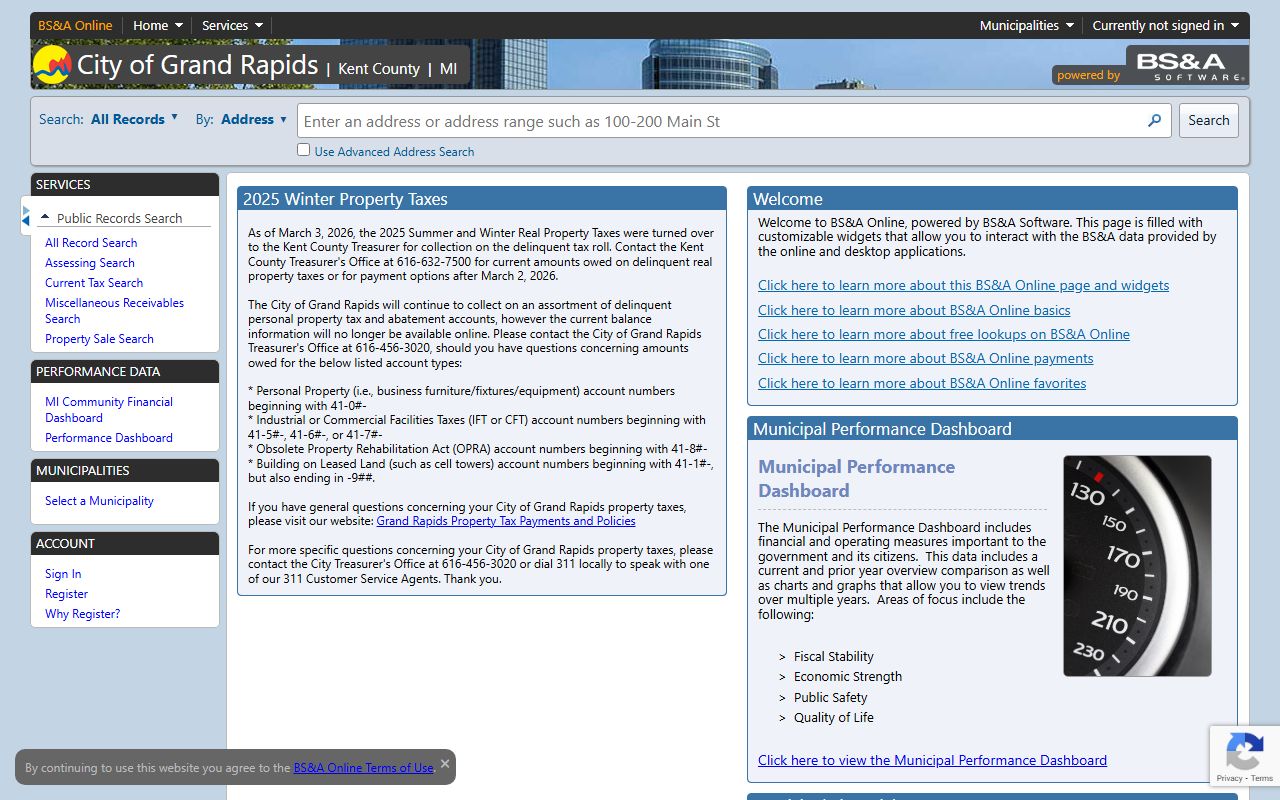
The screenshot below shows the BS&A Online portal for the City of Grand Rapids. This is the main starting point for searching Grand Rapids property tax records.
The Grand Rapids Assessor's Office can also be reached directly for records questions or issues that the online portal cannot resolve.
Grand Rapids Assessor's Office
City Assessor Paula Jastifer leads the Grand Rapids Assessor's Office, which sets assessed values for all real and personal property in the city each year. The office applies the Michigan standard of 50% of true cash value as required by MCL 211.1. Assessment notices go out annually in February, and property owners have a set window to review their values and file appeals if needed. The office also handles exemption filings, including the Principal Residence Exemption, which can significantly reduce school taxes for qualifying homeowners.
| Office | City of Grand Rapids Assessor's Office |
|---|---|
| City Assessor | Paula Jastifer |
| Address | 300 Monroe Ave. NW, 3rd Floor Grand Rapids, MI 49503 |
| Phone | 616-456-3081 |
| Fax | 616-456-4608 |
| assessorgr@grcity.us | |
| Hours | Mon-Fri: 8:00 AM - 5:00 PM |
| Website | Grand Rapids Assessor's Office |
| Online Search | BS&A Online - Grand Rapids |
The office uses Kent County GIS integration and property mapping tools that tie into the BS&A system. Interactive online mapping lets you view property boundaries and related parcel data for Grand Rapids properties. If a parcel boundary or legal description looks incorrect, contacting the Assessor's Office is the right step.
Property Tax Assessment in Grand Rapids
All Grand Rapids properties are valued each year as of December 31, Michigan's statutory Tax Day under MCL 211.30. The assessed value must be 50% of the property's true cash value. Taxable value is a separate number and is capped each year at the rate of inflation or 5%, whichever is lower, as long as the property does not change hands. When a sale or ownership transfer occurs, the taxable value uncaps and resets to the assessed value the following year. For buyers, this can mean a meaningful jump in taxes compared to what the previous owner paid.
Grand Rapids covers a mix of residential, commercial, and industrial parcels across a relatively dense urban footprint. The city assessor conducts field reviews and updates parcel data on a rolling basis. If your property has changed, perhaps an addition was built or a structure was torn down, that should eventually be reflected in your assessment. If you think your record has not been updated, contact the Assessor's Office to flag it. The Michigan Treasury explains how state law governs this process for all Michigan municipalities.
Property Tax Exemptions in Grand Rapids
Grand Rapids property owners can apply for several exemptions that reduce their tax burden. The Principal Residence Exemption (PRE) under MCL 211.7u removes 18 mills from the school operating tax for owners who use the property as their primary home. File Form 2368 with the Assessor's Office by June 1. This exemption applies automatically in future years as long as nothing changes, but you do need to file it the first time. It is worth doing even if you think you already have it, since it only takes a few minutes to confirm.
The Poverty Exemption is available for low-income homeowners in Grand Rapids. You must file Form 5737 and Form 4988 with the Assessor's Office and meet income and asset requirements. The Board of Review rules on poverty exemption requests each March. Disabled veterans may also qualify for a full or partial property tax exemption under Michigan law. Agricultural exemptions apply to land meeting the state definition of agricultural use under MCL 211.7v, though this is less common within Grand Rapids city limits than in surrounding townships.
Note: If you are unsure whether you have the PRE on file, check your assessment notice or call the Assessor's Office at 616-456-3081.
Appealing Your Grand Rapids Assessment
Owners who believe their Grand Rapids property is overassessed can challenge the value through the appeal process. The first step is the March Board of Review, which meets each year to hear assessment protests. You must file before the local deadline set by the city. The Assessor's Office has appeal forms available, and you can also get guidance on what evidence helps your case. Bring a recent appraisal, comparable sales data, or any other documentation that supports a lower value.
If the March Board of Review does not resolve the dispute, you can file with the Michigan Tax Tribunal. For residential property, the MTT filing deadline is July 31. For commercial property, the deadline is May 31. The MTT handles property tax appeals from across the state and provides a formal hearing process. Your rights throughout this process are protected under the Property Taxpayer's Bill of Rights, MCL 205.735. If you need help, the Assessor's Office can point you toward local resources or you can contact the MTT directly at 517-335-9760.
Property Tax Payments in Grand Rapids
Grand Rapids property taxes are billed twice a year. Summer taxes are due by September 14 and winter taxes are due by February 14. These due dates are specific to Grand Rapids and Kent County. If you miss a deadline, interest and penalties begin to accrue. After taxes become delinquent beyond the city's collection period, they transfer to the Kent County Treasurer for collection. The Kent County Treasurer handles delinquent tax records and payment arrangements for parcels in Grand Rapids.
Delinquent taxes that go unpaid long enough can lead to forfeiture and eventually foreclosure. Michigan law provides a multi-year process before a property reaches that stage, but the interest and fees add up fast. If you are behind on Grand Rapids property taxes, contact the Kent County Treasurer's office to understand your options and current balance. Acting early gives you more options and a lower total amount to resolve.
Kent County Property Tax Records
Grand Rapids is in Kent County. All property tax records for the city ultimately connect to the Kent County system. Visit the county page for equalization office information, GIS tools, Register of Deeds access, and resources that cover the full county area.
Nearby Cities
These nearby Michigan cities also have property tax records pages with local assessor information and search resources.