
Access Property Tax Records in Kent County
Kent County is home to Grand Rapids, Michigan's second-largest city, and maintains a robust system for accessing property tax records online. The Kent County Equalization Department at 300 Monroe Ave. NW in Grand Rapids oversees assessment equalization for all parcels in the county. The county's property search portal and BS&A Online give the public access to parcel data, assessed values, and tax history for cities and townships throughout Kent County. This guide covers where to search, who to contact, and how the assessment and appeal process works here.
Kent County Overview
How to Search Kent County Property Tax Records
Kent County offers two primary ways to search property tax records online. The main tool is the Kent County property search portal, which provides comprehensive parcel data across cities and townships. You can search by owner name, parcel number, or address. Results include assessed values, taxable values, school district, and tax history. BS&A Online is also available for individual cities and townships within Kent County where local units participate in that platform.
The county portal is the best starting point because it covers all of Kent County in one search. Grand Rapids, Wyoming, Kentwood, Walker, and the county's townships are all accessible through this system. The portal is free to use and does not require registration for basic lookups. For GIS mapping and parcel boundary information, the Kent County GIS system offers interactive maps linked to parcel data.
The screenshot below shows the Kent County Equalization property search and Treasurer portals. Both tools are used to access Kent County property tax records and assessment data.
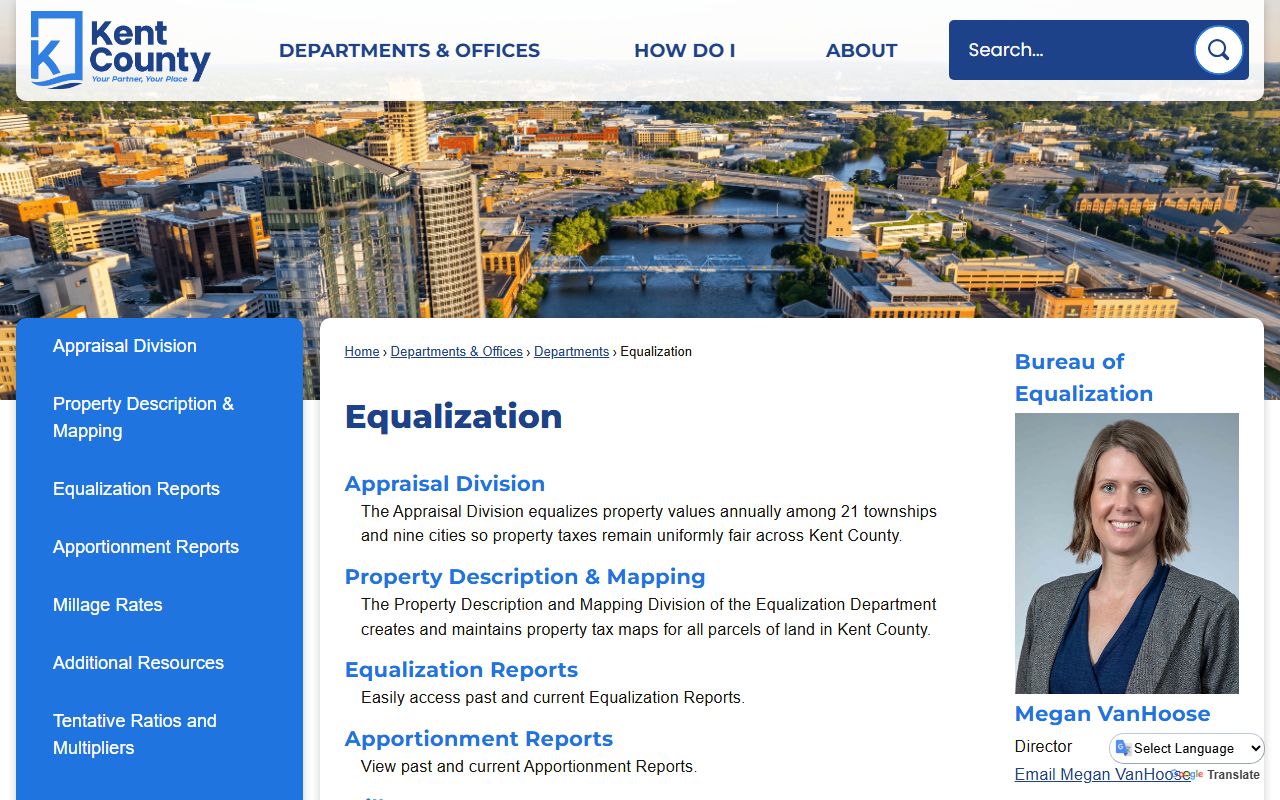
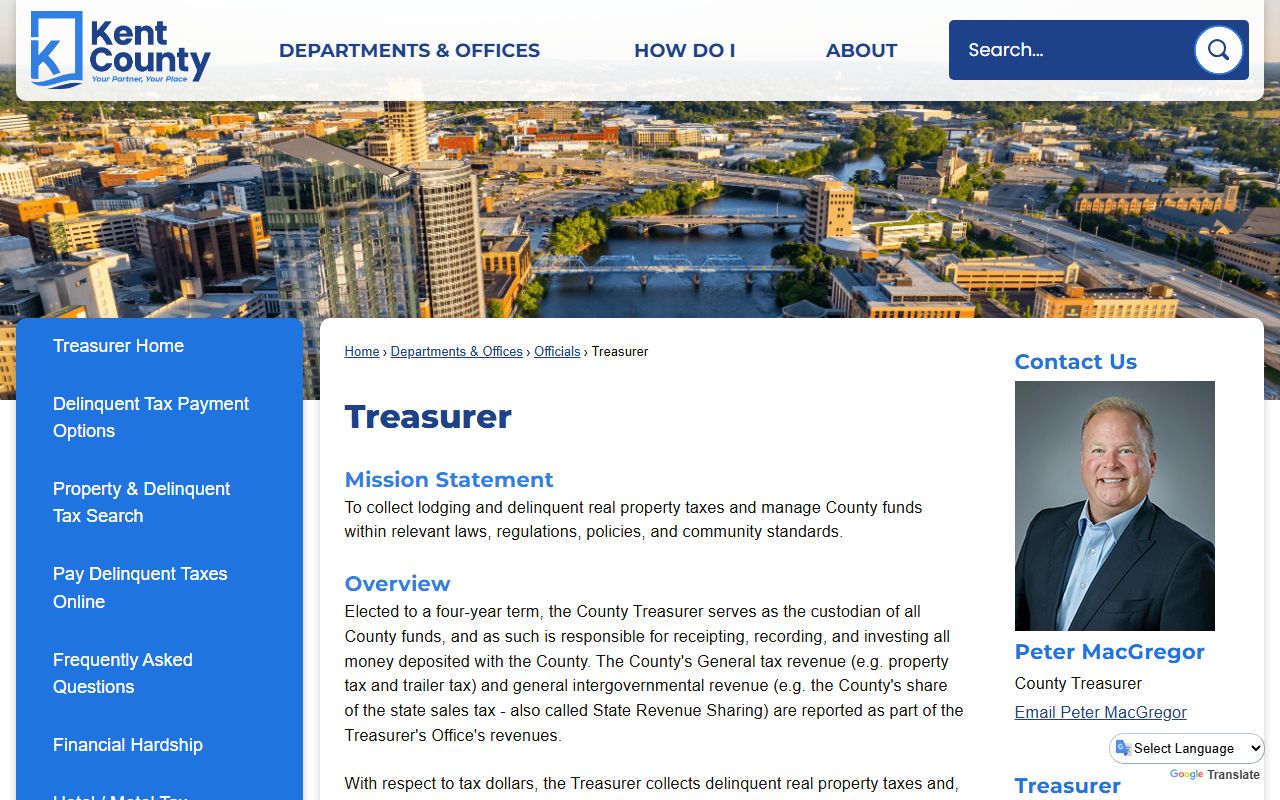
Both portals are maintained by Kent County and reflect current assessment year information. If data appears inconsistent between systems, contact the Equalization Department to clarify.
Kent County Equalization Department
The Kent County Equalization Department is responsible for reviewing and equalizing township and city assessments each year. Director Matthew M. VanSloten leads a team that ensures all parcels in the county are assessed at 50% of true cash value, as required by MCL 211.1 et seq.. With 661,000 residents and a large number of commercial, industrial, and residential parcels, Kent County is one of Michigan's largest and most complex assessment jurisdictions. The department monitors local unit assessment levels and applies equalization factors where needed.
The office also handles special assessment rolls, processes exemption documentation, and maintains the county's property database. Records are public and available during office hours at 300 Monroe Ave. NW in Grand Rapids. Many records are also available online through the county's property search portal. If you have questions about parcel data, value methodology, or exemption status, the Equalization Department can help.
| Office | Kent County Equalization Department |
|---|---|
| Director | Matthew M. VanSloten |
| Address | 300 Monroe Ave. NW, Grand Rapids, MI 49503 |
| Phone | 616-632-7550 |
| Online Search | Kent County Property Search |
| GIS Mapping | Kent County GIS |
Kent County Register of Deeds
The Kent County Register of Deeds records all real estate instruments that affect property in the county. Deeds, mortgages, liens, discharges, easements, and other documents are filed here and are part of the permanent public record. Register Lisa M. Posthumus Lyons oversees the office, which is also at 300 Monroe Ave. NW in Grand Rapids. You can search recorded documents online through the Kent County Register of Deeds website. Call 616-632-7610 for assistance with document requests or questions about recorded instruments.
After any sale or transfer of real estate in Kent County, the new owner must file a Property Transfer Affidavit (Form L-4025) with the local assessor within 45 days. Skipping this step can cause problems with the assessment uncapping process and may result in exemption issues. The standard recording fee in Michigan is $30 per document. Copies are $1 per page, and certified copies are $5. Always confirm that a deed or instrument has been properly recorded before relying on it to establish ownership or tax status.
Note: The Register of Deeds does not handle property tax payments or assessment appeals. Those go to the Treasurer and Equalization Department respectively.
Property Tax Assessment in Kent County
Property in Kent County is valued as of December 31 each year under MCL 211.30. Local assessors in each city and township set individual parcel values, and the Equalization Department reviews those values to confirm they hit the required 50% of true cash value. Assessment notices go out in February. Each notice shows both the assessed value and the taxable value, which is what your tax bill is actually based on.
Michigan's taxable value cap limits annual increases to the lesser of the inflation rate or 5%. This means long-term property owners often have taxable values much lower than their assessed values. The gap closes when the property sells. After a transfer, the taxable value uncaps and resets to the full assessed value in the next tax year. For buyers in a fast-moving market like Grand Rapids, this can mean a substantial jump in property taxes after purchase. Use the Michigan Property Tax Estimator to model taxes before closing on any Kent County property.
Kent County includes urban cores, dense suburbs, and rural townships, all with different millage rates. Grand Rapids, Wyoming, Kentwood, and Walker each set their own millage structures. School districts add their own levies on top of local and county rates. The Michigan Treasury property tax resource explains how all of these layers combine to form your total tax bill.
Property Tax Exemptions in Kent County
The Principal Residence Exemption is available to all Kent County homeowners who use their property as a primary home. Under MCL 211.7u, the PRE removes 18 mills from the school operating tax on your property. File Form 2368 with your local city or township assessor by June 1. In a county with millage rates that can vary significantly by jurisdiction, the PRE can make a real difference in your annual tax bill.
Agricultural property in Kent County's rural townships may qualify for an exemption under MCL 211.7v. The property must meet the statutory definition of agricultural use, and the exemption applies to qualifying operations that are actively farmed. Contact your township assessor to confirm eligibility and obtain the necessary forms.
The Poverty Exemption is available to low-income homeowners who meet income and asset requirements. File Form 5737 and Form 4988 with your local assessor before the March Board of Review. Disabled veterans and qualifying surviving spouses may also be eligible for a full or partial property tax exemption under Michigan law. Kent County cities and townships each process these exemptions locally, so contact your specific assessor's office to start the application.
Appealing Your Kent County Assessment
Kent County property owners who believe their assessment is too high can appeal through the established process. The first step is the March Board of Review in your city or township. Boards meet each March to hear protests from property owners. You can attend in person or file a written protest before the deadline. Bring solid evidence: a recent independent appraisal, a recent sale price for the property, or comparable sales data from the immediate area are the most persuasive forms of support.
If the Board of Review does not resolve your concern, you can petition the Michigan Tax Tribunal. The MTT hears appeals from property owners across the state and is not part of the county government. Residential property appeals must be filed by July 31. Commercial and industrial property appeals are due by May 31. The MTT can be reached at 517-335-9760. Your rights throughout the appeal process are spelled out in the Property Taxpayer's Bill of Rights under MCL 205.735.
Kent County Property Tax Payments
Summer and winter property taxes in Kent County are collected at the local level first. Cities and townships each have their own treasurers who handle billing and collection. Summer taxes are generally due in September, and winter taxes come due in February. Exact deadlines vary by jurisdiction. Check with your city or township treasurer to confirm dates for your specific parcel.
After the local collection period ends, unpaid taxes become delinquent and are forwarded to the Kent County Treasurer. Treasurer Peter J. MacGregor's office handles delinquent collections, payment plans, and properties that have entered forfeiture. The office is at 300 Monroe Ave. NW in Grand Rapids and can be reached at 616-632-7700. More information is available on the Kent County Treasurer website. Michigan law allows properties to enter forfeiture after one year of delinquency and foreclosure after three years, so addressing outstanding taxes promptly is critical.
Cities in Kent County
Kent County includes several large cities. Grand Rapids is the county seat and the largest city in the county. Wyoming, directly south of Grand Rapids, is also one of Michigan's larger cities. Both Grand Rapids and Wyoming have dedicated city pages with more information on local property tax resources. Kentwood, Walker, and other cities in the county do not meet the threshold for dedicated pages but handle property tax records through their own local assessors within the county framework.
Nearby Counties
These counties border Kent County. Each runs its own equalization office and property tax system. If a parcel sits near a county line, verify which county it belongs to before searching.