
Property Tax Records in Branch County
Branch County property tax records are kept by the County Equalization Department at 31 Division St. in Coldwater. The county uses the BS&A Online platform to give the public access to parcel data, assessed values, taxable values, and tax history. This guide explains how to search Branch County property tax records online and in person, how the assessment process works, what exemptions may apply to your property, and how to appeal if your assessed value seems off.
Branch County Overview
How to Search Branch County Property Tax Records
Branch County uses the BS&A Online system for public property tax record access. The Branch County BS&A Online portal lets you search by owner name, property address, or parcel number. Search results include the current assessed value, taxable value, legal description, and tax payment history. The system covers all townships in Branch County, so you can find any parcel in the county with a single search.
The portal is free and requires no registration for basic lookups. It is updated regularly to reflect current tax year data. If you need records not available online, the Equalization Department at 517-279-4313 can help. Director Troy L. Crowell's office is at 31 Division St. in Coldwater. Staff are available during regular business hours to answer questions about parcel data, assessed values, and exemptions. The Michigan Treasury property tax page provides useful statewide context on how assessments and equalization work across Michigan.
The screenshot below shows the BS&A Online portal used by Branch County to provide public access to property tax records.
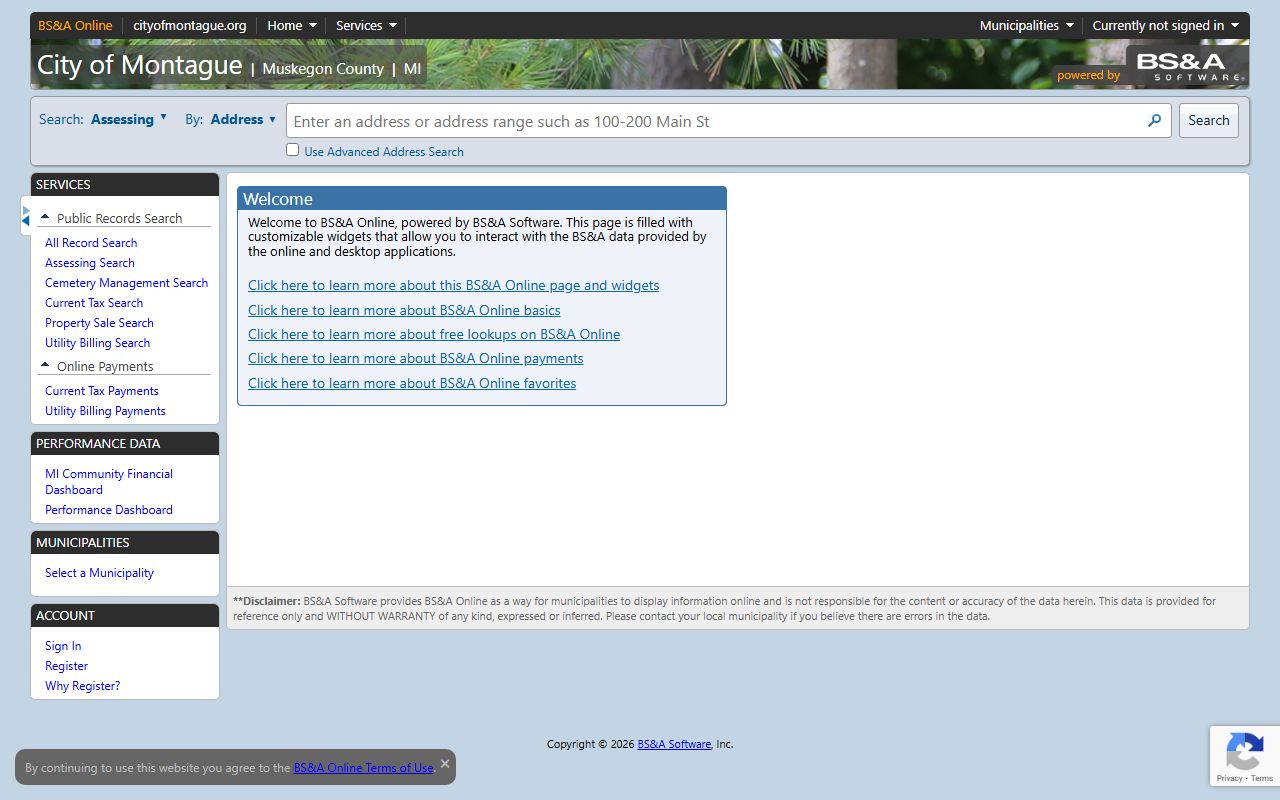
This portal reflects current parcel and tax data for all townships and communities in Branch County.
Branch County Equalization Department
The Equalization Department is the central office for property tax records in Branch County. Director Troy L. Crowell oversees the annual equalization process, which reviews township property assessments and brings them into compliance with state law. Under MCL 211.1 et seq., all Michigan property must be assessed at 50% of its true cash value. Each spring, the county compares local assessment levels against sales data and adjusts township equalized values as needed. Branch County includes a mix of residential, agricultural, and commercial property spread across a dozen townships and several cities and villages.
The department maintains the county parcel database, reviews exemption applications, and coordinates with township assessors on data accuracy. Records held by the department are public. You can view them at the office or request them by phone. If your question relates to a specific parcel or township, staff can point you to the right assessor or answer directly if the information is available at the county level.
| Office | Branch County Equalization Department |
|---|---|
| Director | Troy L. Crowell |
| Address | 31 Division St., Coldwater, MI 49036 |
| Phone | 517-279-4313 |
| Online Search | BS&A Online - Branch County |
Branch County Register of Deeds
The Register of Deeds in Branch County records all real estate documents that affect property ownership. This includes deeds, mortgages, liens, and land contracts. Register Bronwyn T. McMullen can be reached at 517-279-4306. The office is at 31 Division St. in Coldwater. When a property in Branch County changes hands, the new owner must file a Property Transfer Affidavit (Form L-4025) with the local assessor within 45 days. This affidavit triggers the uncapping of taxable value as required by Michigan law, which adjusts the tax base for the new owner starting the following year.
Copies of recorded documents cost $1 per page, and certified copies are $5. The recording fee for new documents is $30. When researching a Branch County property, reviewing both the Register of Deeds records and the BS&A tax portal gives you the most complete picture. Deed records confirm ownership and show any encumbrances, while the BS&A portal shows current assessed values and tax status.
Note: The Property Transfer Affidavit must be filed even if the transfer is between family members. Failing to file within 45 days results in a penalty under state law.
Property Tax Assessment in Branch County
Property in Branch County is assessed as of December 31 each year, Michigan's Tax Day under MCL 211.30. Township assessors value each parcel, and the County Equalization Department reviews those values to ensure they reach the required 50% of true cash value. Assessment notices go out to property owners in February. The assessed value on your notice reflects what the assessor believes your property is worth based on market data from the prior year.
Taxable value in Michigan is capped and grows no faster than the lesser of inflation or 5% annually as long as the same owner holds the property. A sale or transfer resets taxable value to the assessed value the following year. In Branch County, where property values in some areas have risen faster than the cap allows, new buyers can face a larger tax bill than the previous owner paid. If you are buying a property in Branch County, use the Michigan Property Tax Estimator to project your post-purchase tax bill before closing. Millage rates vary by township and school district, so the estimator is the best way to get a realistic number.
Property Tax Exemptions in Branch County
Branch County property owners have access to several exemptions that can lower their annual tax bill. The Principal Residence Exemption (PRE) is the most widely claimed. Under MCL 211.7u, if you own and occupy your Branch County property as your primary residence, you can exempt 18 mills from your school operating tax. File Form 2368 with your local assessor by June 1. The PRE does not apply to rental properties, second homes, or commercial parcels.
Branch County has a significant amount of agricultural land, and qualifying farm operations can claim an exemption under MCL 211.7v. Eligible property must meet the state's definition of agricultural property. If your land qualifies, this exemption can provide meaningful relief, especially on larger farm parcels. Contact the Equalization Department to confirm eligibility and review what documentation the county needs to process your application.
Low-income homeowners can apply for the Poverty Exemption each March by submitting Form 5737 and Form 4988 to their township assessor before the Board of Review convenes. Disabled veterans and surviving spouses may also be eligible for a property tax exemption under Michigan law. Ask the Equalization Department about the current income thresholds and application requirements.
Appealing a Branch County Property Tax Assessment
If you think your Branch County property is assessed too high, you can protest the value at the March Board of Review. The Board meets each March to hear appeals from property owners in each township. You can appear in person or submit a written protest before the deadline set by your local assessor. Supporting evidence matters. A recent appraisal, sales data from comparable properties nearby, or documentation of property condition issues can all strengthen your case. The Board issues a decision in writing after reviewing submissions.
If the Board of Review decision does not resolve your concern, the next step is the Michigan Tax Tribunal. The MTT hears property tax appeals statewide. The deadline for residential property owners is July 31, and for commercial property owners it is May 31. Call the MTT at 517-335-9760 for filing instructions. The Property Taxpayer's Bill of Rights under MCL 205.735 protects your right to a fair process and a written explanation of any decision made about your assessment.
Branch County Property Tax Payments
Property taxes in Branch County are billed at the township level. Summer taxes go out in July and are usually due in September. Winter taxes follow in December with a February due date, though this varies slightly by township. Check with your local township treasurer to confirm the exact deadlines for your parcel. Once taxes become delinquent, they are forwarded to the Branch County Treasurer, Anne D. Renner, who can be reached at 517-279-4305.
Delinquent taxes in Michigan carry interest and penalties that increase the longer they go unpaid. At a certain point, the county must begin the forfeiture process, which can eventually lead to foreclosure and loss of property. If you have a delinquent balance on a Branch County parcel, contact the Treasurer's office to get the current total and discuss your payment options. Resolving delinquency early costs less and avoids the risk of losing the property.
Note: Michigan law requires the county to pursue forfeiture once taxes reach a certain age, so there is a real deadline for addressing unpaid amounts.
Cities in Branch County
Branch County includes the city of Coldwater as its county seat, along with Quincy, Bronson, and Union City. Several townships round out the county's communities. None of these municipalities meet the population threshold for individual city pages on this site. Property tax records for all areas in Branch County can be searched through the BS&A Online portal linked above.
Nearby Counties
These counties border or sit near Branch County in southern Michigan. Each has its own equalization office and property tax record system. If a parcel is near a county line, verify which county holds the record before you search.