
Calhoun County Property Tax Records
Calhoun County property tax records are managed by the Equalization Department in Marshall, Michigan. Property owners, buyers, and researchers can search parcel data, check assessed values, and review taxable value history for any parcel in the county. The BS&A Online portal makes it easy to look up Calhoun County property tax records without visiting a county office. This guide explains how to search, who maintains the records, and what steps to take if you need to appeal your assessment or claim an exemption.
Calhoun County Overview
How to Search Calhoun County Property Tax Records
The main tool for searching Calhoun County property tax records online is the BS&A Online portal. It covers all townships and cities in the county and lets you look up parcels by owner name, address, or parcel number. You can see assessed value, taxable value, school district, and recent tax history. The system is free to use for basic searches.
The Calhoun County Equalization Department uses BS&A Online to give the public access to parcel data. Once you find a parcel, you can view its full assessment record. This includes prior year values, property class, and any exemptions that are active. The data comes directly from local assessing offices in each city and township, so it reflects current conditions.
The portal shown below is where most people start when they need Calhoun County property tax records. It covers all taxable parcels across the county's townships and municipalities. The Calhoun County BS&A property search portal provides current assessment and tax data for every parcel in the county.
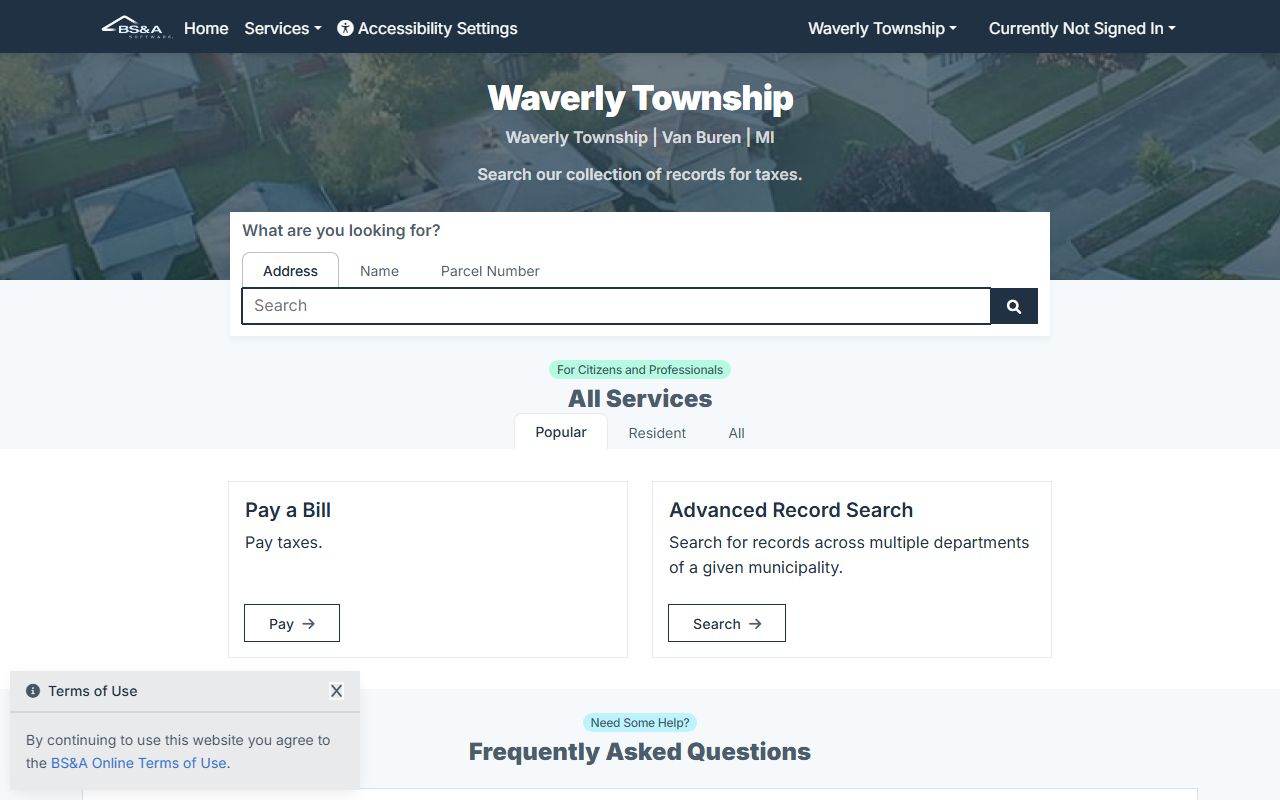
After you locate a parcel, the system shows the property address, owner name, legal description, and assessed value history. You can also see whether a Principal Residence Exemption or other exemption is on file. Print or save the results for your own records. If you need certified documents, you must contact the Equalization Department or the local assessing office directly.
Note: The BS&A portal is updated by local assessing officers throughout the year, but data may not reflect changes made in the last few weeks.
Calhoun County Equalization Department
The Calhoun County Equalization Department is responsible for making sure all property in the county is assessed at the same standard. Under MCL 211.1 et seq., every parcel must be assessed at 50% of its true cash value as of Tax Day, which is December 31 each year. The Equalization Director reviews assessments across all local units and makes adjustments if any township or city is out of line with state standards.
Joshua H. Smith serves as the Equalization Director for Calhoun County. His office reviews local assessments, handles equalization studies, and helps local assessors apply state rules consistently. The department also maintains the county's parcel database and works with the Calhoun County GIS mapping system to keep spatial data current. If you have questions about your parcel's classification or how your assessed value was set, the Equalization Department is a good starting point.
| Department | Calhoun County Equalization |
|---|---|
| Director | Joshua H. Smith |
| Address | 315 W. Green St., Marshall, MI 49068 |
| Phone | 269-781-0747 |
| Hours | Monday through Friday, 8:00 AM to 5:00 PM |
| Online Search | BS&A Online Portal |
| GIS Mapping | Calhoun County GIS |
Calhoun County Register of Deeds
The Calhoun County Register of Deeds records property transfers, mortgages, liens, and other documents that affect title. Anne B. Norlander serves as Register of Deeds. Her office is located at the same courthouse complex in Marshall at 315 W. Green St. You can reach the Register of Deeds at 269-781-0735.
When a property sells, the seller or buyer must record the deed with the Register of Deeds. This triggers the Property Transfer Affidavit requirement under state law. The buyer has 45 days to file Form L-4025 with the local assessor. Failure to file on time may result in a penalty. The recorded deed also gives the assessor notice that the property changed hands, which can affect the assessed value in the next assessment cycle.
Standard recording fees in Michigan are $30 per document. Copies cost $1 per page, and certified copies cost $5 per document. If you need to research the ownership history of a Calhoun County parcel, the Register of Deeds has grantor/grantee indexes going back many decades. Staff can help you find older records that may not be in an online system.
Property Tax Assessment in Calhoun County
Property taxes in Calhoun County start with the annual assessment. Under MCL 211.30, the assessment date is December 31 of the prior year. Local assessors in each township and city set the assessed value at 50% of true cash value. The state equalizes these assessments to make sure all counties are at the same ratio.
Michigan law caps how fast your taxable value can grow each year. Even if your assessed value jumps, taxable value can only increase by the rate of inflation or 5%, whichever is less. This cap resets when the property sells. After a sale, the taxable value is uncapped and set equal to the assessed value for the next year. This is one of the most important things to know if you are buying property in Calhoun County. Your first tax bill after purchase may be much higher than the prior owner's bill.
Assessment notices go out each February. They show your current assessed value, taxable value, and the deadline to appeal. Property owners have until the March Board of Review to challenge their assessment. The Michigan Department of Treasury sets the rules that local assessors must follow. You can also use the Michigan Property Tax Estimator to get an idea of what your bill might look like at different assessed values.
Property Tax Exemptions in Calhoun County
Several exemptions can lower your Calhoun County property tax bill. The most common is the Principal Residence Exemption. Under MCL 211.7u, if your home is your primary residence, you may qualify for an 18-mill exemption on the school operating levy. To claim it, file Form 2368 with your local assessor by June 1 of the tax year. The exemption stays in place until you move or sell the property.
Agricultural land in Calhoun County may qualify for a reduced rate under MCL 211.7v. Farmland that is actively used for agricultural production and enrolled in the program is assessed at its agricultural use value rather than its market value. This can result in a big reduction in taxable value for working farms in the county.
Low-income property owners may apply for a poverty exemption. File Form 5737 and Form 4988 with the local assessor before the March Board of Review. The board reviews income information and decides whether to grant a full or partial exemption. Disabled veterans and their surviving spouses may also qualify for an exemption from property taxes under state law. Contact the Calhoun County Equalization Department at 269-781-0747 to ask about which exemptions apply to your parcel.
Note: All exemption forms must be filed with your local city or township assessor, not the county Equalization Department.
Appealing Your Calhoun County Assessment
If you think your Calhoun County property is assessed too high, you have the right to appeal. The first step is the March Board of Review. This board meets each March in your local township or city. You can appear in person, send a letter, or in some cases appear by phone or video. Bring evidence like a recent appraisal, comparable sales data, or photos showing the condition of your property.
Under the Michigan Taxpayer's Bill of Rights, MCL 205.735, you have the right to a fair hearing and a written explanation if your appeal is denied. If the Board of Review does not resolve your issue, you can appeal to the Michigan Tax Tribunal. For residential property, the MTT deadline is July 31. For commercial and industrial parcels, the deadline is May 31. The MTT can be reached at 517-335-9760.
The Calhoun County Treasurer, John T. Bippus, handles tax payments and delinquent accounts. His office is at 315 W. Green St. in Marshall and can be reached at 269-781-0805. If you have questions about your tax bill, payment options, or delinquency status, the Treasurer's office is the right contact. Paying taxes under protest does not waive your right to appeal your assessment.
Cities in Calhoun County
Calhoun County includes several cities and townships. No cities in Calhoun County meet the population threshold for individual city pages on this site. Larger communities in the county include Battle Creek, Marshall, Albion, Homer, and Springfield. Property tax records for all of these areas are searchable through the Calhoun County BS&A portal.
Nearby Counties
Calhoun County borders several other counties in south-central Michigan. Each county has its own assessing offices and property tax records.