
Find Property Tax Records in Hillsdale County
Hillsdale County property tax records are kept by the County Equalization Department at the courthouse in Hillsdale. The department maintains assessment data for every parcel in the county and makes it available through an online search portal. You can look up assessed values, taxable values, and current tax status for any Hillsdale County property. The Treasurer's office handles billing, and the Register of Deeds records all property ownership changes.
Hillsdale County Overview
Hillsdale County Equalization Department
The Hillsdale County Equalization Department oversees all property assessments in the county. Tami M. Ridenour serves as Director and can be reached at 517-437-3391. The office is located at 29 N. Howell St. in Hillsdale, MI 49242. The department reviews assessments submitted by local township and city assessors, checks that values are at the state-required 50% of true cash value, and equalizes them if needed. They also process property transfer affidavits, splits, and new parcel descriptions.
Public access to Hillsdale County property tax records is available through the BS&A Online portal for Hillsdale County. You can search by owner name, property address, or parcel number. The system displays current and prior-year assessed values, taxable values, millage rates, and tax bill amounts. This portal is the fastest way to research any property in the county without going to the courthouse.
| Director | Tami M. Ridenour |
|---|---|
| Address | 29 N. Howell St., Hillsdale, MI 49242 |
| Phone | 517-437-3391 |
| Online Search | BS&A Property Search Portal |
For certified records or documents not available online, contact the Equalization office directly. Staff can pull historical assessment data and help identify the correct parcel number if you have only an address.
Hillsdale County Property Tax Portal
The BS&A system used by Hillsdale County is the same platform used by many Michigan counties. The portal shows the screenshot below, which represents the public-facing search interface used to access Hillsdale County property tax data.
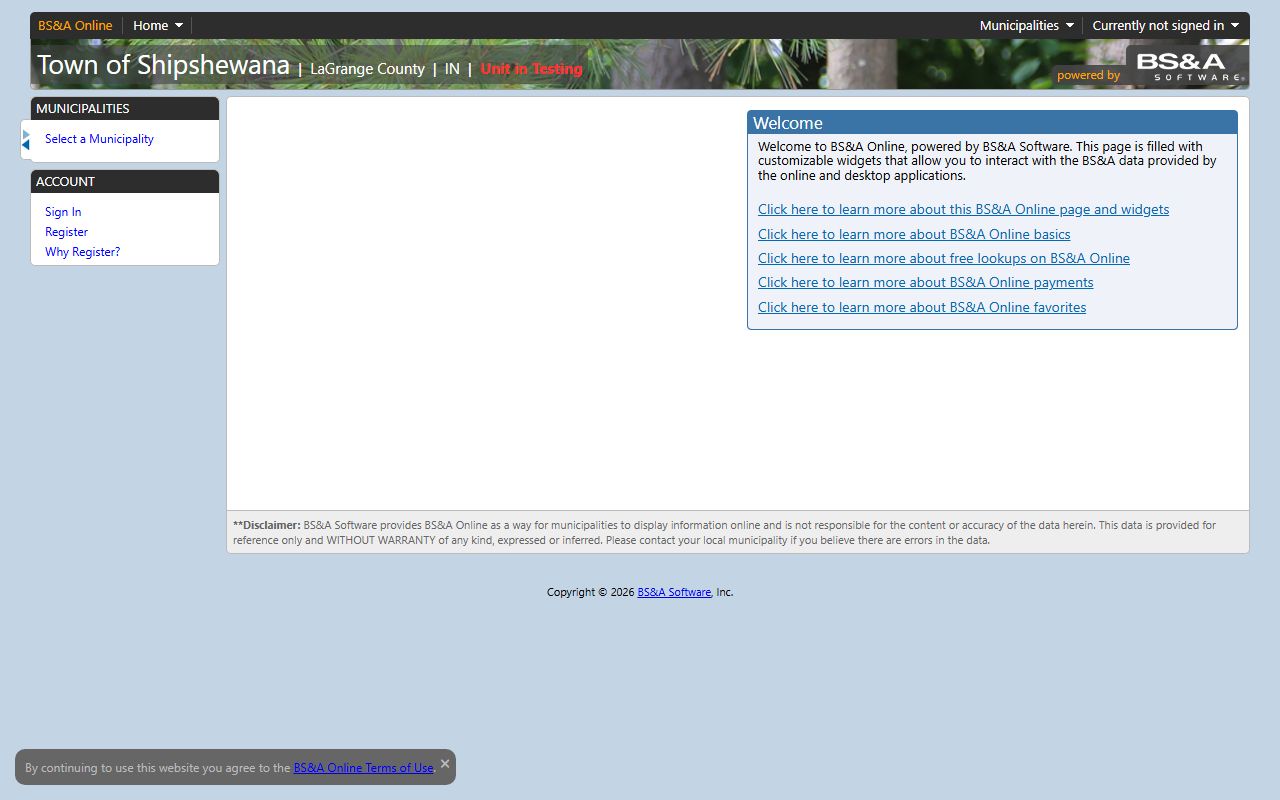
Search by owner name or parcel number to view full assessment history, tax bills, and property details for any Hillsdale County parcel.
Michigan law under MCL 211.1 requires that all real property be assessed. In Hillsdale County, assessors in each township and city handle the initial valuations. The Equalization Department then reviews those numbers and corrects any that are not at 50% of true cash value. Both the assessed value and the taxable value appear in the BS&A portal, which lets you see if your property has a cap on its taxable value.
Most searches are free. If you need a printed certified copy of assessment data or a letter confirming ownership, the office charges a small fee. Those requests should be made in person or by mail to 29 N. Howell St., Hillsdale, MI 49242.
Assessments and Appeals in Hillsdale County
Property in Hillsdale County is valued as of December 31 each year, which is Michigan's Tax Day. Assessment notices go out in February. If you think the assessed value is too high, you can challenge it. The process starts with the local Board of Review in March. Each township and city in Hillsdale County holds its Board of Review meetings during this month. You can appear in person or file a written protest. Bring evidence such as recent comparable sales or an independent appraisal to support your case.
If you do not get the result you want at the Board of Review, the next step is the Michigan Tax Tribunal. The Tribunal (517-335-9760) is an independent state agency that handles property tax appeals. For homestead and agricultural property, the filing deadline is July 31. For commercial and industrial property, the deadline is May 31. You do not need a lawyer to file, but many owners find it helpful for more complex cases.
Note: Appealing at the Board of Review in March is required before you can file at the Michigan Tax Tribunal for assessed value disputes.
Property Tax Exemptions in Hillsdale County
The Principal Residence Exemption is the most widely used property tax relief program in Hillsdale County. Under MCL 211.7u, homeowners who occupy their home as their primary residence can exempt the property from up to 18 mills of school operating taxes. That is a meaningful savings on most tax bills. You file Form 2368 with the local assessor's office. The deadline is June 1 for the summer tax bill and November 1 for the winter bill. You only need to file once as long as you stay in the home.
Farmland in Hillsdale County may qualify under MCL 211.7v for the agricultural property exemption. Like the PRE, this removes the 18-mill school operating levy from qualified agricultural parcels. The assessor determines eligibility based on use. Most active farmland in the county qualifies.
Low-income homeowners can apply for the poverty exemption at the March Board of Review. You submit Form 5737 and Form 4988 with supporting income documentation. The board decides how much of a reduction to grant based on financial need. Some qualifying households receive a full exemption. Seniors and disabled veterans should ask the Equalization office about additional programs that may apply.
Hillsdale County Register of Deeds
The Register of Deeds office records all property ownership documents in Hillsdale County. Alisa M. Kellenberger serves as Register of Deeds and shares the office at 517-437-3391 at the Hillsdale County courthouse on 29 N. Howell St. Every deed, mortgage, and property transfer gets recorded here. Once recorded, a deed becomes part of the public land record. The Equalization Department uses deed records to update ownership information and trigger taxable value uncapping after a sale.
When you purchase property in Hillsdale County, you must file Form L-4025, the Property Transfer Affidavit, within 45 days of the closing date. This form notifies the assessor of the sale price and new ownership. Missing the 45-day window brings a penalty. Recording fees are $30 for the first page of a document. Copies of recorded documents cost $1 per page, and a certified copy is $5. These fees apply at the Register of Deeds counter or by mail request.
The deed record also shows easements, liens, and other encumbrances on a property. Reviewing the deed before purchasing land in Hillsdale County helps you understand what comes with the property and avoid surprises at the tax office.
Hillsdale County Treasurer
Lisa A. Learman serves as Hillsdale County Treasurer, and her office is also at 29 N. Howell St. with phone 517-437-3391. The Treasurer sends out property tax bills and collects payments. Summer taxes are typically billed in July and due September 14. Winter taxes are billed in December and due February 14. Taxes not paid to the local township or city by March 1 become delinquent and transfer to the County Treasurer's office for collection.
Once taxes go delinquent, the county adds a four-percent administration fee and charges one percent interest per month. After three years of unpaid taxes, Michigan law allows the county to begin foreclosure proceedings. The Treasurer's office can give you a payoff amount for delinquent taxes including all fees and interest. The Michigan Department of Treasury also has resources for property owners facing tax trouble, including information about payment plans.
Hillsdale County property taxes left unpaid for three years can lead to tax foreclosure. Contact the Treasurer's office at 517-437-3391 before that point.
Taxpayer Rights in Hillsdale County
Under MCL 205.735, Michigan's Taxpayer Bill of Rights gives Hillsdale County property owners the right to a fair assessment, access to the data behind it, and the ability to appeal. You can request your property record card from the local assessor at any time. This card lists the data points the assessor used, such as square footage, age, quality rating, and extra features. Comparing your card against others in the neighborhood can reveal errors that support an appeal.
You can also use the Michigan property tax estimator to see what your bill should look like given your assessed value and local millage rates. If the estimate differs from your actual bill, contact the Equalization Department to review the numbers. The state tool is free and does not require an account. It is a good first check before deciding whether to appeal.
Nearby Counties
Hillsdale County is in the south-central part of Michigan's Lower Peninsula. These counties border Hillsdale and handle their own property tax records.