
Monroe County Property Tax Records
Monroe County property tax records are handled by the County Equalization Department located at the Monroe County Courthouse on S. Macomb St. The county sits in the southeast corner of Michigan, bordering Ohio and Lake Erie. Owners and researchers can search parcel data, assessment figures, and tax history through the BS&A online portal. Monroe County also offers GIS mapping tools for property lookups. This page covers how to search Monroe County property tax records, who the key offices are, and what options you have for exemptions and appeals.
Monroe County Overview
How to Search Monroe County Property Tax Records
Monroe County gives the public two main ways to look up property tax records online. The primary tool is the BS&A Online portal, which covers all townships, cities, and villages in the county. You can search by owner name, property address, or parcel number. Results include current assessed and taxable values, legal descriptions, ownership history, and tax amounts for current and prior years. No login is needed for basic parcel lookups.
Visit the Monroe County BS&A property search to use the online portal. The portal includes tax, assessment, and delinquent search options. Monroe County also provides GIS mapping, which lets you look up parcels by location on a map. The GIS tool is available through the county equalization page at co.monroe.mi.us. Using both tools together gives you a more complete picture of a property, especially if you are researching a parcel by location rather than address or parcel ID.
The screenshot below shows the BS&A search portal for Monroe County. This is where most online property tax record searches in Monroe County begin.
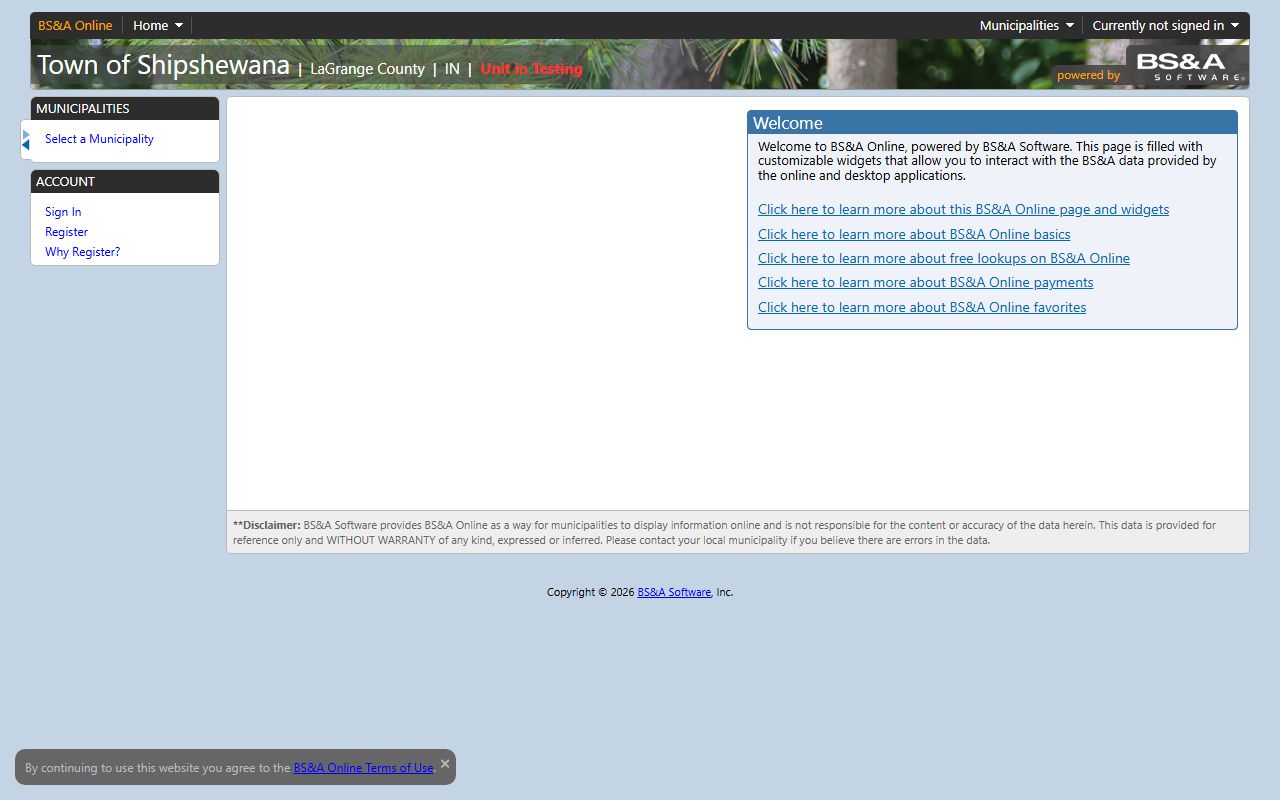
For in-person research or records not available through the online systems, visit the Equalization Department at 51 S. Macomb St. in Monroe.
Monroe County Equalization Department
Director Jeff C. Saylor leads the Monroe County Equalization Department. The office is responsible for reviewing all township assessments in the county and certifying that they comply with the state requirement under MCL 211.1 et seq. that all property be assessed at 50% of true cash value. Monroe County has a mix of residential subdivisions, agricultural land, and commercial areas, all of which require their own assessment methodology. The Equalization Department coordinates these reviews each spring.
The office also handles exemption inquiries, special assessment rolls, and property data questions from owners and researchers. Monroe County property records are public. Staff can assist with parcel lookups and questions about how specific values were determined. Call ahead to confirm office hours and what documents to bring for your visit.
| Office | Monroe County Equalization Department |
|---|---|
| Director | Jeff C. Saylor |
| Address | 51 S. Macomb St., Monroe, MI 48161 |
| Phone | 734-240-7350 |
| Online Search | BS&A Online - Monroe County |
| GIS Mapping | Monroe County GIS Mapping |
Monroe County Register of Deeds
The Monroe County Register of Deeds records and indexes all real property documents filed in the county. Deeds, mortgages, land contracts, liens, and easements are all maintained here. After a property sale, the buyer must file a Property Transfer Affidavit (Form L-4025) with the local assessor within 45 days of closing. This filing triggers the uncapping of taxable value, which is a required step under Michigan law after any transfer of ownership. Failing to file on time can cause confusion in the assessment record, so it is worth doing promptly.
The Monroe County Register of Deeds also provides online access to recorded documents through the county website. Register Michael E. Bosanac oversees the office, which shares the same courthouse address at 51 S. Macomb St. in Monroe. The phone number for the Register of Deeds is 734-240-7390. Standard Michigan recording fees apply: $30 per document to record, $1 per page for copies, and $5 for certified copies.
Note: Always verify that ownership in the deed records matches what the tax records show before completing a property transaction.
Property Tax Assessment in Monroe County
Monroe County property assessments are based on conditions as of December 31 each year, per MCL 211.30. Township and city assessors value every parcel in their jurisdiction, and the Equalization Department reviews those figures in the spring to confirm they hit the 50% of true cash value standard. Assessment notices go out in February. Read yours carefully, since it shows both the assessed value and the taxable value.
These two values matter for different reasons. The assessed value reflects the market estimate at 50%, while the taxable value is what your tax rate actually applies to. In Michigan, taxable value is capped and can only rise by the lesser of inflation or 5% per year while the property stays under the same ownership. When a property sells, that cap ends and taxable value resets upward to match the assessed value the following year. For Monroe County buyers, especially those purchasing properties that have not sold in many years, this can mean a big increase in taxes starting in year two of ownership. The Michigan Property Tax Estimator is a useful tool to run before closing. The Michigan Treasury provides more detail on how assessment and capping work statewide.
Property Tax Exemptions in Monroe County
Monroe County property owners have access to several exemptions that can lower their tax bills. The Principal Residence Exemption (PRE) under MCL 211.7u removes 18 mills of school operating tax for homeowners who use the property as their primary residence. File Form 2368 with your local assessor by June 1 to claim it. This is one of the largest routine reductions available to individual homeowners in Michigan.
Farm operations in Monroe County may qualify for an exemption under MCL 211.7v. Monroe County has agricultural land along with residential and commercial areas, and qualifying farms can reduce their assessed tax burden. The Poverty Exemption is available for homeowners who meet income and asset standards. File Form 5737 and Form 4988 with your township assessor before the Board of Review convenes each March. Disabled veterans and surviving spouses may also qualify for separate exemptions. Ask the Equalization Department or your local assessor which programs apply to your situation.
Appealing Your Monroe County Assessment
Monroe County property owners who believe their assessed value is too high can challenge it through the formal Michigan appeal process. The first stop is the March Board of Review, which is held at the local township or city level. You must submit a written protest or appear in person before the Board's closing date. Bring strong evidence: a recent independent appraisal, comparable sales of similar properties in your area, or a clear market analysis. Weak evidence rarely results in a reduction.
If the Board of Review rules against you or you want a further review, file a petition with the Michigan Tax Tribunal. The MTT is an independent body that hears property tax disputes from all Michigan counties. The deadline to file for residential property is July 31. Commercial property owners must file by May 31. The Property Taxpayer's Bill of Rights under MCL 205.735 protects your rights at each stage. Reach the MTT at 517-335-9760 for filing questions.
Monroe County Property Tax Payments
Local township and city treasurers in Monroe County collect summer and winter taxes directly. Summer taxes are usually due in September and winter taxes in February, though exact dates depend on the local unit. Pay at the township or city level first. After taxes become delinquent, they are turned over to the Monroe County Treasurer's office. Treasurer Michael J. Bosanac manages delinquent collections and can be reached at 734-240-7375.
Once taxes are delinquent with the County Treasurer, fees and interest begin to accumulate. Michigan law allows foreclosure on parcels with three years of unpaid taxes. If you have delinquent taxes in Monroe County, contact the Treasurer's office as soon as possible to discuss your options. Payment plans may be available and can stop the fee clock from running up further. Resolving delinquent taxes also protects your title and ability to sell or refinance the property.
Note: Contact your local township treasurer to confirm your exact summer and winter tax due dates, since they can differ from the county-level defaults.
Cities in Monroe County
Monroe County includes the city of Monroe, which is the county seat, along with communities such as Monroe Township, Frenchtown Township, and the Village of Petersburg. None of these municipalities reach the population threshold for individual city pages on this site. Property tax records for all Monroe County communities are available through the county Equalization Department and the BS&A online portal.
Nearby Counties
Monroe County is in the southeast corner of Michigan and borders Ohio to the south. The Michigan counties listed below each have their own equalization offices and property records systems. If a parcel is near a county line, verify which county it belongs to before running your search.