
Wayne County Property Tax Records
Wayne County is Michigan's most populous county, home to Detroit and dozens of other cities and townships. Property tax records here are managed through the Wayne County Equalization Department on the 6th floor of 400 Monroe St. in Detroit. The county operates an online property search portal, a treasurer's tax payment system, and a GIS mapping tool, giving property owners and researchers several ways to access parcel data, assessed values, and tax history. This guide covers all of those resources and explains how assessment, exemptions, and appeals work in Wayne County.
Wayne County Overview
How to Search Wayne County Property Tax Records
Wayne County provides several online tools for searching property tax records. The main starting point is the county's equalization portal at waynecounty.com/departments/equalization. This page links to property records, assessment data, and search tools that cover parcels throughout the county. From here you can access parcel information for the City of Detroit, suburban cities, and townships that make up Wayne County's 34 jurisdictions.
The screenshot below shows the Wayne County Equalization property search portal, the main online resource for Wayne County property tax records.
For tax payment status, delinquent balances, and payment history, use the Wayne County Treasurer's property tax portal at pta.waynecounty.com. This system lets you search by parcel number or address to see current and delinquent tax amounts, payment history, and due dates. For delinquent-specific lookups, use the Wayne County Delinquent Tax Payment portal.
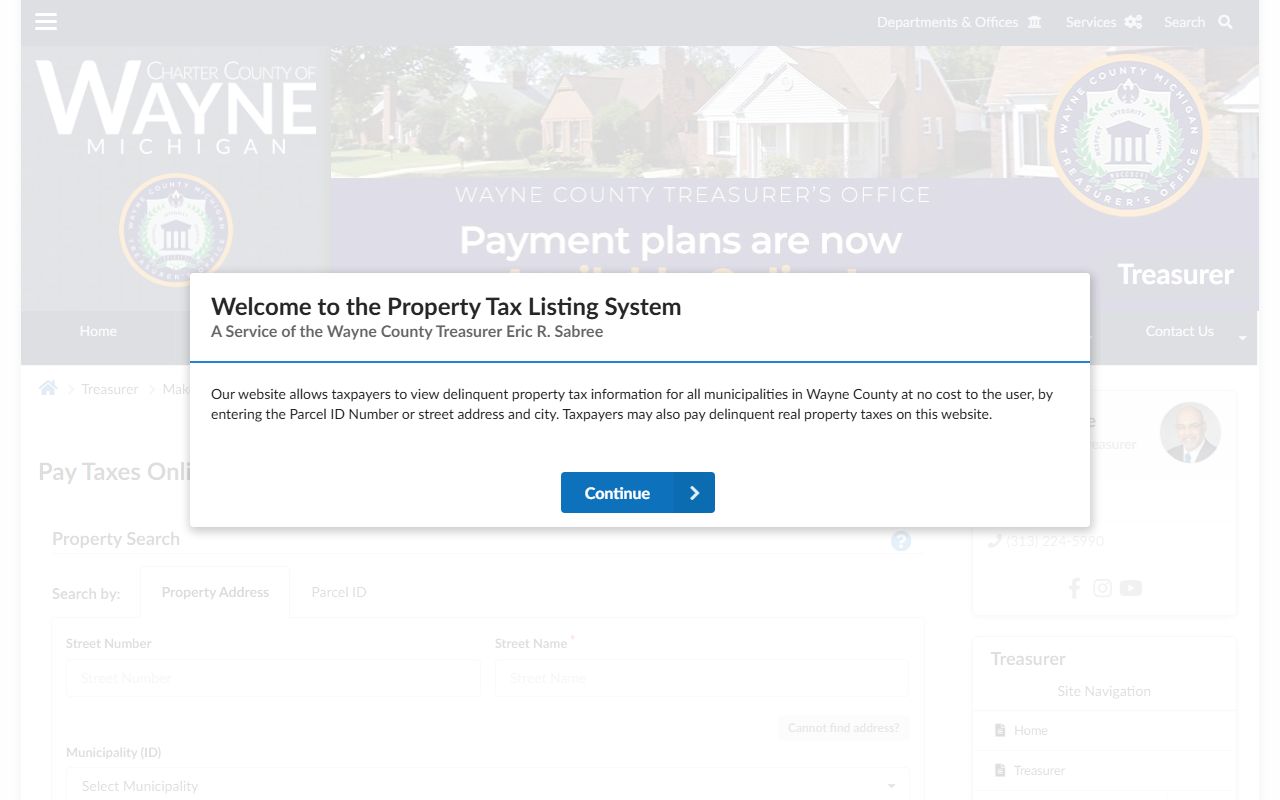
The screenshot below shows the Wayne County Treasurer's property tax payment portal, used for checking tax status and making payments online.
Wayne County's GIS mapping system at waynecounty.com/departments/cao/gis provides parcel boundaries, aerial imagery, and location data. Use it to confirm which municipality a parcel belongs to, especially near city boundaries where jurisdiction can be unclear. The Equalization Department is at 400 Monroe St., 6th Floor, Detroit, MI 48226. Phone: 313-224-3560.
Wayne County Equalization Department
Director Anthony J. Zacho leads the Wayne County Equalization Department. Under MCL 211.1, all property in Michigan must be assessed at 50% of true cash value. Zacho's department reviews assessment rolls from all 34 cities and townships in Wayne County, compares values to actual sales data, and applies equalization factors where adjustments are needed. Given the scale of Wayne County, this is a significant annual undertaking covering hundreds of thousands of parcels across a wide range of property types.
The department also oversees exemption processing, special assessment rolls, and the county's parcel data systems. If you have a question about how a property was assessed, which city or township assessor handles a given parcel, or what programs you might qualify for, the Equalization Department is the right first contact. Most property records are public and accessible during regular business hours at 400 Monroe St., 6th Floor, Detroit.
| Director | Anthony J. Zacho |
|---|---|
| Address | 400 Monroe St., 6th Floor, Detroit, MI 48226 |
| Phone | 313-224-3560 |
| Property Search | Wayne County Equalization Portal |
| GIS Mapping | Wayne County GIS System |
The screenshot below shows the Wayne County GIS mapping system, which displays parcel boundaries across all cities and townships in the county.
The GIS tool is particularly helpful in Wayne County given the large number of municipalities with different assessors and tax rates.
Wayne County Register of Deeds
Register Bernard J. Youngblood records all real estate instruments in Wayne County. This includes deeds, mortgages, land contracts, liens, and easements for parcels across the entire county. The Register of Deeds is a busy office given the volume of transactions in Michigan's most populated county. Recorded documents are accessible through the county's online search tools at waynecounty.com/departments/register-of-deeds.
When a property is sold or transferred in Wayne County, the new owner must file a Property Transfer Affidavit (Form L-4025) with the local city or township assessor within 45 days of the transfer. Failing to file this form on time can result in penalties and a delay in resetting the taxable value. The Register of Deeds office is at 400 Monroe St., 5th Floor, Detroit, MI 48226. Phone: 313-224-5850. Michigan's standard recording fee is $30 per document, copies are $1 per page, and certified copies are $5.
Note: In Wayne County's larger cities, particularly Detroit, some property transfers involve complex title histories. Using a title company familiar with Wayne County records can help catch any outstanding liens or encumbrances before closing.
Property Tax Assessment in Wayne County
Property in Wayne County is assessed as of December 31 each year under MCL 211.30. City and township assessors set values for their jurisdictions, and the Equalization Department reviews all of those values annually against sales data. Assessment change notices go out in February. Wayne County's property market is diverse, ranging from high-value suburban homes in communities like Grosse Pointe to a large stock of urban residential and commercial property in Detroit.
Michigan's taxable value cap limits annual tax increases for existing owners to the lesser of inflation or 5%. When property is sold, this cap lifts and taxable value resets to equal the assessed value in the following tax year. Given the range of property values across Wayne County, this reset can mean very different things depending on where the property is located. Buyers should use the Michigan Property Tax Estimator to calculate expected post-purchase taxes. More information about statewide assessment rules is at Michigan Treasury property tax.
Property Tax Exemptions in Wayne County
Wayne County homeowners can claim the Principal Residence Exemption (PRE) to eliminate 18 mills of school operating tax. Under MCL 211.7u, you qualify if the property is your primary home. File Form 2368 with your city or township assessor by June 1. The exemption renews automatically each year you remain in the property as your main residence. In high-millage communities, the PRE represents significant annual savings.
Agricultural property in Wayne County's remaining rural townships may qualify for the Agricultural Exemption under MCL 211.7v. Qualifying operations can get meaningful tax relief. Contact the township assessor to confirm eligibility.
The Poverty Exemption is available to low-income homeowners across Wayne County who file Form 5737 and Form 4988 before the March Board of Review. Disabled veterans and surviving spouses may also qualify for state-mandated exemptions. Some Wayne County cities have additional local programs. Contact your city or township assessor to ask what is available in your jurisdiction.
Appealing Your Wayne County Assessment
Property owners in Wayne County who believe their assessed value is too high can appeal. The first step is the March Board of Review at the city or township level. File a written protest or appear in person before the Board's deadline. Evidence matters. A licensed appraisal, comparable sales data from similar properties nearby, or documentation of property defects or damage can all support your case. The Board can reduce your assessed value if the evidence is persuasive.
If the Board of Review result is not satisfactory, the next step is the Michigan Tax Tribunal. The MTT handles property tax appeals from owners across the state. Residential appeals must be filed by July 31 and commercial appeals by May 31. The MTT is at 517-335-9760. Your rights throughout the process are protected under the Property Taxpayer's Bill of Rights, MCL 205.735.
Wayne County Property Tax Payments
Treasurer Eric R. Sabree manages property tax collection and delinquent tax administration for Wayne County. Local cities and townships collect current-year summer and winter taxes. Summer taxes are generally due in September and winter taxes in February, though each municipality sets its own exact deadlines. Contact your local city or township treasurer for the specific dates that apply to your parcel.
The Wayne County Treasurer's online property tax portal at pta.waynecounty.com lets you check current tax status, view payment history, and make online payments. Delinquent tax payments can also be made through the Wayne County Delinquent Tax portal. After taxes go delinquent and transfer to the county, interest and fees begin to accumulate. Contact the Treasurer's office at 313-224-5990 if you are behind on taxes or want to set up a payment plan. Acting early limits total costs and protects your property from foreclosure.
Note: Wayne County follows Michigan's standard delinquency and foreclosure timelines. Properties with taxes unpaid for three or more years become eligible for county foreclosure under state law.
Cities in Wayne County
Wayne County includes several cities that qualify for individual pages on this site. Detroit is Michigan's largest city and the county seat. Dearborn, Livonia, Westland, and Canton Township also meet the population threshold. These cities each have their own assessors who handle local property tax records, though all fall under the Wayne County Equalization Department for annual review and equalization.
Nearby Counties
Wayne County borders these Michigan counties. Each has its own equalization office and property records. Confirm which county holds a parcel before searching, especially for properties near county lines.