
Osceola County Tax Records Search
Osceola County property tax records are managed by the County Equalization Department in Reed City. The county has over 21,500 parcels, spanning a mix of residential, commercial, and agricultural land. Residents and researchers can look up parcel data, assessed values, and tax history through online search tools. This guide covers how to search Osceola County property tax records, which offices maintain them, and how to challenge an assessment if you think your value is too high.
Osceola County Overview
How to Search Osceola County Property Tax Records
Osceola County property tax records are searchable through the Michigan Property Checker at michigan.propertychecker.com/osceola-county. The portal allows searches by address or zip code, which makes it straightforward if you know the property location. Results include assessment details and parcel information for properties throughout the county. This tool covers all 21,511 parcels in Osceola County across all townships.
The screenshot below shows the Osceola County Equalization and BS&A property tax search portal. This is the primary online resource for finding Osceola County property tax records.
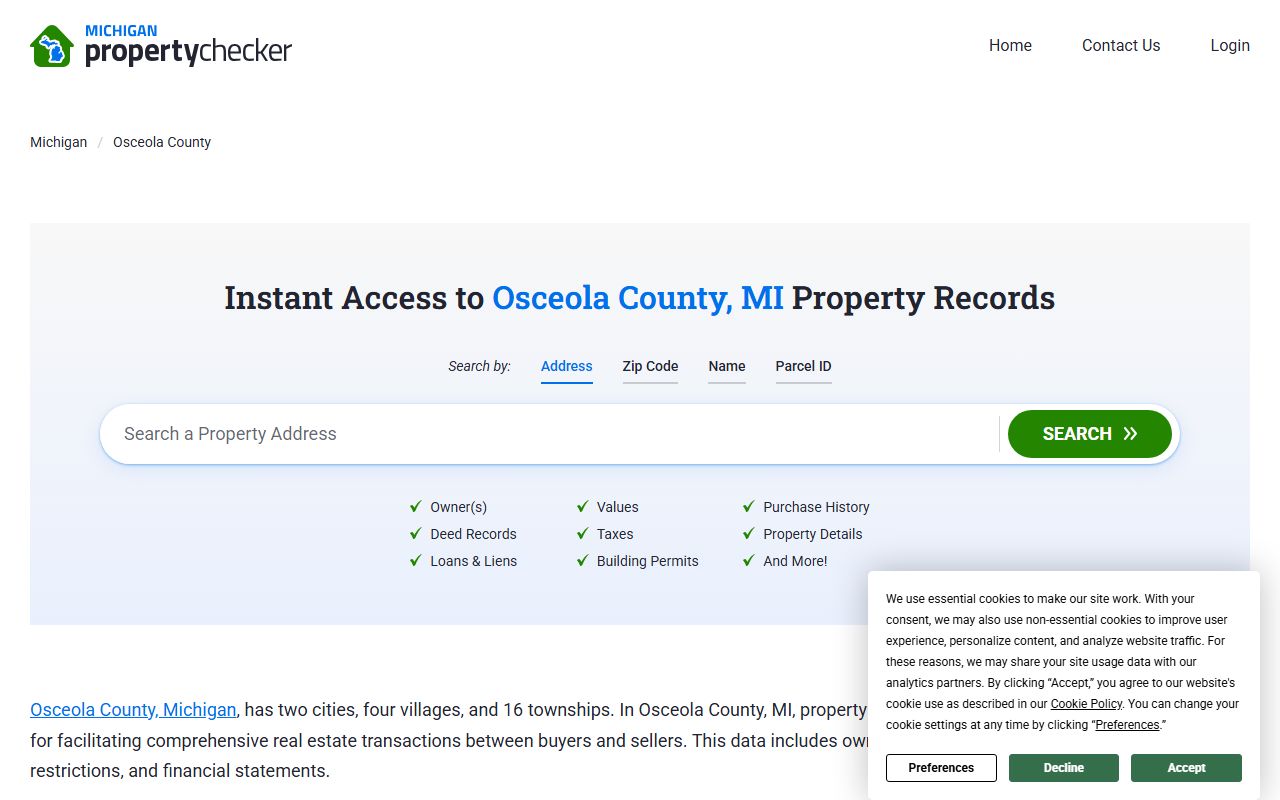
The portal is kept up to date with the current tax year. If you run into trouble with an online search or need records that aren't available through the portal, the Equalization Department in Reed City can help. In-person visits and phone calls are good options for more detailed requests or questions about how a specific value was set.
The Michigan Treasury also provides statewide property tax search resources and guidance that can help if county-level tools don't have what you need.
Osceola County Equalization Department
The Equalization Department handles property assessment oversight for all of Osceola County's parcels. Under MCL 211.1 et seq., all Michigan property must be assessed at 50% of its true cash value. The Equalization Department reviews the annual values set by township assessors and adjusts them to ensure the entire county meets that state standard. Osceola County's 21,511 total parcels include 18,291 residential parcels and 1,167 commercial parcels, with the remainder being agricultural and other property types.
The office also manages special assessment rolls and handles exemption review. Most Osceola County property records are public and can be reviewed during business hours or through the online portal. If you have a question about a specific parcel's value or exemption status, this is the office to contact.
| Office | Osceola County Equalization Department |
|---|---|
| County Seat | Reed City, MI |
| Total Parcels | 21,511 |
| Online Search | Michigan Property Checker - Osceola County |
| State Resource | Michigan Treasury - Property Tax |
Osceola County Register of Deeds
The Register of Deeds records all real estate documents in Osceola County. Deeds, mortgages, liens, releases, and other instruments that affect property ownership are filed at this office. Recorded documents are used alongside assessment records to trace ownership history and verify the status of a property. When a property changes hands in Osceola County, the new owner should file a Property Transfer Affidavit (Form L-4025) with the local assessor within 45 days of the transfer.
The standard recording fee in Michigan is $30 per document. Copies cost $1 per page. Certified copies are $5 per document. The Register of Deeds office can confirm recorded instruments and provide copies. Contact the courthouse in Reed City for current hours and access options. Some Osceola County deed records may be searchable online, though availability depends on how far back the records have been digitized.
Note: Filing the Property Transfer Affidavit on time after a sale ensures the taxable value cap is properly addressed in the next assessment year.
Property Tax Assessment in Osceola County
Property in Osceola County is assessed as of December 31 each year under MCL 211.30. Township assessors set values across the county's townships, and the Equalization Department reviews those values for compliance with the 50% of true cash value standard. Assessment notices go out in February. Both the assessed value and the taxable value appear on the notice. These numbers often differ, and understanding why helps you read your tax bill accurately.
Michigan limits taxable value increases to the lesser of the inflation rate or 5% per year, as long as the property does not sell. When it does sell, the taxable value cap lifts and resets to the full assessed value in the following tax year. For buyers of Osceola County property where the prior owner held it for many years, this can mean a significant tax increase. Use the Michigan Property Tax Estimator before closing to get a realistic sense of future taxes. Local millage rates vary by township, so rates differ across the county even for similar types of property.
Property Tax Exemptions in Osceola County
The Principal Residence Exemption (PRE) reduces the school operating tax for Osceola County homeowners who live in their property as their primary residence. Under MCL 211.7u, the PRE removes 18 mills from your school operating tax. File Form 2368 with your local assessor by June 1 to claim it. The exemption holds year to year without renewal, but you must notify the assessor if you move out or begin renting the property.
Osceola County has a substantial amount of agricultural land. Farm operations that meet the state's definition may qualify for an exemption under MCL 211.7v. The Poverty Exemption is available for low-income homeowners who pass income and asset tests. File Form 5737 and Form 4988 with your local assessor. The March Board of Review rules on those requests each year. Veteran exemptions are also available under Michigan law for qualifying disabled veterans and their surviving spouses.
Appealing Your Osceola County Assessment
If you believe your Osceola County property is overassessed, start with the March Board of Review. It meets each March to hear protests from property owners. You can appear in person or submit a written protest before your local township's deadline. Bring strong evidence of value, such as a recent appraisal or sales data for comparable properties nearby. The Board of Review is the primary place to dispute the assessed value for the current year.
If the Board of Review doesn't resolve your issue, file a petition with the Michigan Tax Tribunal. The MTT hears appeals from all Michigan counties. The filing deadline for residential property is July 31. For commercial property, it is May 31. Reach the MTT at 517-335-9760. The Property Taxpayer's Bill of Rights under MCL 205.735 defines your rights throughout the appeal process.
Note: Act before the Board of Review deadline; missing it generally means waiting until next year to challenge the assessed value.
Osceola County Property Tax Payments
The Osceola County Treasurer collects delinquent property taxes after local townships turn them over. Summer taxes are typically due in September and winter taxes in February, though exact due dates vary by township. Contact your local township treasurer to confirm your specific payment deadlines. Keeping taxes current avoids the delinquency process, which adds interest and fees to the balance owed.
After taxes become delinquent and are forwarded to the county, the Treasurer manages collections, payment arrangements, and properties in forfeiture. Michigan law allows property to be foreclosed if taxes remain unpaid long enough. If you're behind on Osceola County property taxes, contact the Treasurer's office early. Payment plans may be available in some situations. Resolving the debt sooner reduces the total amount you end up owing due to interest accumulation.
Cities in Osceola County
Osceola County is a rural county in central Michigan. Reed City is the county seat. Other communities include Evart, LeRoy, and Marion. None of these municipalities reach the population threshold for individual city pages. Property tax records for all communities in Osceola County are handled through the Equalization Department and the county's online search portal.
Nearby Counties
These counties border Osceola County. Each has its own equalization office and property tax records system. If you're unsure which county a parcel belongs to near a border, verify before searching.