
Access Dearborn Property Tax Records
Dearborn property tax records are maintained by the City Assessor's Office and are available to the public through the BS&A Online portal. Located in Wayne County with about 109,000 residents, Dearborn handles its own assessment process while delinquent taxes are managed by the Wayne County Treasurer. This guide explains how to search Dearborn property tax records online, what the Assessor's Office does, how assessments work, which exemptions are available, how to appeal, and how taxes are collected and what happens when they go unpaid.
Dearborn Overview
How to Search Dearborn Property Tax Records
Dearborn uses the BS&A Online portal for Dearborn as its public records search tool. No login is needed for basic parcel lookups. You can search by parcel number, property address, or owner name. Results display the current owner, legal description, assessed value, taxable value, property class, assessment history, and tax payment records. The portal is updated regularly and gives you a reliable, current view of any Dearborn parcel without having to visit city offices.
The city also maintains a GIS system with interactive property maps and zoning data. These maps tie to the parcel data in BS&A and are useful when you need to see property boundaries or understand nearby zoning. If you find a discrepancy between the GIS data and what the BS&A portal shows, contact the Dearborn Assessor's Office to report it. The office can investigate and correct records that are out of date or incorrect. Assessment notices go out each February, so comparing your notice against the BS&A data is a good annual check.
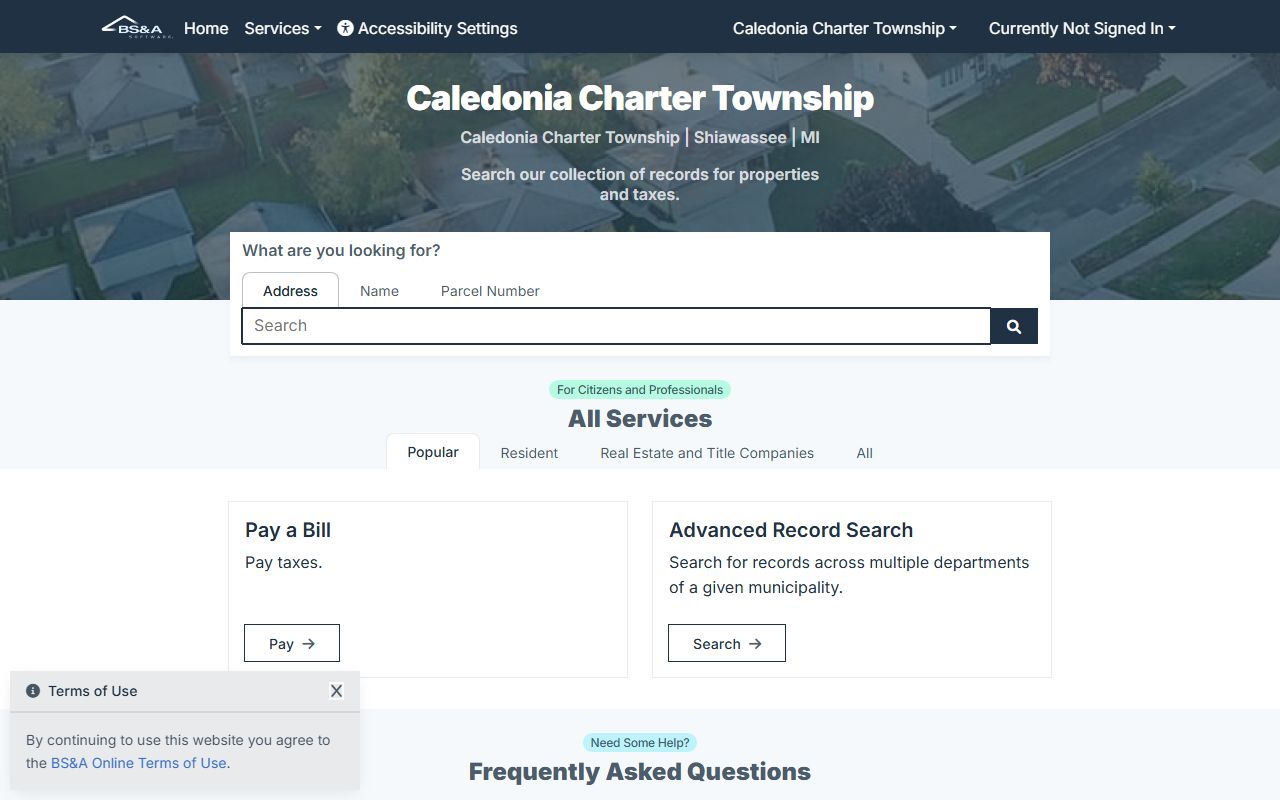
The screenshot below shows the BS&A Online portal used by the City of Dearborn. This is the main tool for searching Dearborn property tax records.
For records that require in-person review or certified copies, visit the Assessor's Office at 16901 Michigan Avenue during regular business hours.
Dearborn Assessor's Office
The City of Dearborn Assessor's Office values all real and personal property in the city each year under MCL 211.1, which requires Michigan property to be assessed at 50% of true cash value. The Assessor's Office conducts field inspections, maintains parcel records, processes exemption applications, and administers the annual assessment roll. The office is located on Michigan Avenue. Tax collection for current bills is handled by the Dearborn City Treasurer. Delinquent taxes are forwarded to the Wayne County Treasurer after the city's collection period ends.
| Office | City of Dearborn Assessor's Office |
|---|---|
| Address | 16901 Michigan Avenue Dearborn, MI 48126 |
| Assessor Phone | (313) 943-2090 |
| Treasury Phone | (313) 943-2110 |
| Wayne County Delinquent | Wayne County Treasurer |
| Online Search | BS&A Online - Dearborn |
The city's GIS system integrates with the parcel data maintained by the Assessor's Office. Zoning maps are also available through the city's planning department and can be viewed alongside property records for a complete picture of any Dearborn parcel. If your property is in a NEZ (Neighborhood Enterprise Zone) area, the Assessor's Office can confirm whether any abatement programs apply to your address.
Property Tax Assessment in Dearborn
Dearborn properties are valued each year as of December 31 under MCL 211.30. The assessed value must equal 50% of each parcel's true cash value. Michigan law also caps taxable value at the lower of the inflation rate or 5% per year for as long as the same owner holds the property. The gap between assessed value and taxable value can be significant for long-term Dearborn homeowners, since the cap means taxable value grows more slowly than market value. When a property sells or transfers, the taxable value uncaps in the following tax year and resets to the full assessed value. New buyers in Dearborn should check the current assessed value in BS&A and compare it to what the seller's taxable value was, to anticipate how taxes may change after closing.
Dearborn includes residential neighborhoods, commercial areas, and properties within NEZ and historic district areas that may have specific assessment rules or abatement programs. Assessment notices go out in February. If your notice lists a value that seems higher than comparable homes are selling for in your area, gather evidence and consider filing a protest. The Assessor's Office conducts field reviews and updates parcel records, so if your property's data is wrong, flag it early rather than waiting for the annual cycle to catch it. The Michigan Treasury provides statewide guidance on how assessment law applies to cities like Dearborn.
Property Tax Exemptions in Dearborn
Dearborn homeowners can claim the Principal Residence Exemption (PRE) under MCL 211.7u if the property is their primary home. The PRE removes 18 mills from the school operating tax, which is a meaningful reduction on any Dearborn tax bill. File Form 2368 with the Assessor's Office by June 1. This is one of the most widely available and valuable exemptions for Michigan homeowners, and it stays in place as long as you own and occupy the home. If you recently bought a home in Dearborn, confirm the PRE is on your record through BS&A. If not, file the form right away.
The Poverty Exemption is available for qualifying low-income homeowners. File Form 5737 and Form 4988 before the March Board of Review and meet income and asset thresholds. The Board of Review decides on poverty exemption requests each March. Dearborn also has NEZ programs that offer tax abatement for certain properties in designated zones. If your property is in one of those zones, ask the Assessor's Office what programs may apply. Historic district exemptions may also be relevant for certain Dearborn properties with historic designations.
Note: NEZ abatement programs are zone-specific and require a separate application process distinct from the PRE or poverty exemption.
Appealing Your Dearborn Assessment
If your Dearborn assessment looks too high, you can challenge it through the March Board of Review. The Board meets each year during dates set by the city. Assessment notices are mailed in February, so you have a few weeks to review your value before the Board meets. File your protest before the deadline and bring evidence. A recent appraisal, comparable sales from similar Dearborn properties, or documentation of physical conditions that reduce value all support a lower assessed value. The Board has the authority to adjust the assessment if your evidence holds up.
If the Board of Review does not resolve the appeal, you can file a petition with the Michigan Tax Tribunal. The MTT is independent of local government and hears property tax appeals from all over Michigan. For residential properties, the filing deadline is July 31. For commercial properties, the deadline is May 31. Your rights through this process are laid out in the Property Taxpayer's Bill of Rights under MCL 205.735. The MTT can be reached at 517-335-9760. Gathering strong evidence and filing on time are the two most important things you can do in any assessment appeal.
Property Tax Payments in Dearborn
Dearborn property taxes are billed in summer and winter installments. The Dearborn City Treasurer handles collection of current tax bills. Contact Treasury at (313) 943-2110 for payment amounts, due dates, and payment options. Once taxes become delinquent, they are forwarded to the Wayne County Treasurer for collection. The Wayne County delinquent tax portal at pta.waynecounty.com lets you search delinquent balances and pay online. The Wayne County Treasurer can also be reached at 313-224-5990.
Delinquent taxes accrue interest and fees quickly under Michigan law. The state's multi-year delinquency process gives owners time to resolve the debt before foreclosure, but the total grows with each passing year. Dearborn property owners who are behind should contact the Wayne County Treasurer as soon as possible to get a current payoff amount and understand what options are available. Addressing delinquency early limits total cost and preserves more paths to resolution.
Note: Delinquent tax records in Wayne County are publicly accessible through the county treasurer portal.
Wayne County Property Tax Records
Dearborn is in Wayne County. All property tax records for the city ultimately connect to the Wayne County system. Visit the county page for equalization office information, GIS tools, Register of Deeds access, and resources that cover the full county area.
Nearby Cities
These nearby Michigan cities also have property tax records pages with local assessor information and search resources.