
Detroit Property Tax Records
Detroit property tax records are managed by the City Assessor's Office and are searchable online through the BS&A Online portal. As Michigan's largest city with about 632,000 residents, Detroit handles its own assessment and tax administration through city departments. You can look up parcel data, assessed values, taxable values, and payment history without leaving your desk. This guide covers how to search Detroit property tax records, how assessments work, what exemptions are available, and how to appeal if your value seems off.
Detroit Overview
How to Search Detroit Property Tax Records
Detroit uses the BS&A Online platform as its primary public search tool for property tax records. You can search by property address or parcel ID without creating an account. Results show the current owner, assessed value, taxable value, property class, legal description, and tax payment history. This system covers all parcels within city limits, so one search covers any Detroit address.
Detroit parcel IDs have a specific format you should know before searching. The parcel number requires a period or dash as the ninth character, for example 12345678. or 12345678-9. If you enter the number without this character, the search may not return results. Double-check the format if your search comes up empty. The portal link is Detroit BS&A property search and it is available any time, day or night.
The screenshot below shows the BS&A Online portal used by the City of Detroit. This is the main tool for finding Detroit property tax records online.
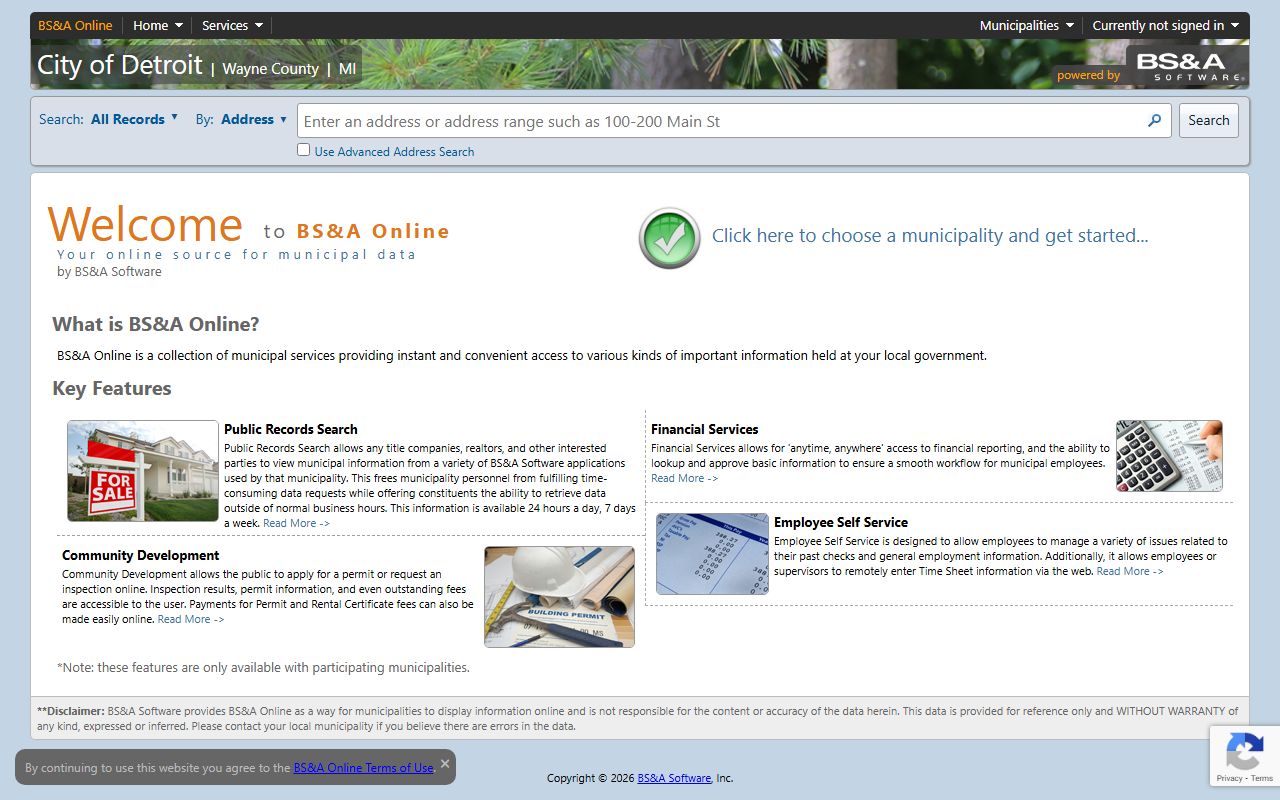
If you cannot find what you need online, visit or call the Assessor's Office directly. Staff can look up parcels by address or owner name and answer questions about specific records.
Detroit Assessor's Office
The Office of the Assessor sits within Detroit's Office of the Chief Financial Officer. It handles annual assessments for all real and personal property within city limits. The office is divided into four main divisions: Administration, GIS and Land Records Maintenance, Operations and Administrative Services, and Valuations and Field Operations. Each plays a role in maintaining the city's property tax records. Under MCL 211.1, all property in Michigan must be assessed at 50% of its true cash value, and Detroit's assessors apply that standard to hundreds of thousands of parcels each year.
| Office | City of Detroit Office of Assessor |
|---|---|
| Address | Coleman A. Young Municipal Center 2 Woodward Ave, Suite 130 Detroit, MI 48226 |
| Phone | (313) 224-3035 |
| asktheassessor@detroitmi.gov | |
| Hours | Mon-Thu: 8:00 AM - 4:30 PM Fri: 8:00 AM - 12:00 PM |
| Website | Detroit Assessor's Office |
| Online Search | BS&A Online - Detroit |
The GIS and Land Records Maintenance division keeps Detroit's property maps current. These maps are tied to the parcel records in BS&A and reflect boundary changes, splits, and combinations as they happen. If a parcel's legal description or boundary does not match what you expect, the Assessor's Office is the right place to ask.
Property Tax Assessment in Detroit
Detroit assessors value property each year as of December 31 under MCL 211.30, which sets Michigan's statutory Tax Day. The assessed value must equal 50% of the property's true cash value. The taxable value is a separate figure and is capped at the rate of inflation or 5%, whichever is lower, for as long as the same owner holds the property. When the property sells or transfers, the taxable value uncaps and resets to the assessed value in the following tax year. This reset can lead to a significant jump in taxes, so buyers should check the current assessed value before closing.
Detroit is unique among Michigan cities because it manages a very large and varied property base, including residential neighborhoods, commercial corridors, and industrial sites in varying stages of use and condition. The city uses the Valuations and Field Operations division to conduct field reviews and update property data. Assessment notices go out each February. If you have not received yours, contact the Assessor's Office or check the BS&A portal for your current values.
The Michigan Treasury property tax page provides background on how state law governs assessments and what rights owners have in the process.
Property Tax Exemptions in Detroit
Detroit offers several programs that can lower your property tax bill. The most common across Michigan is the Principal Residence Exemption (PRE). Under MCL 211.7u, if the property is your primary home, you can remove 18 mills from the school operating portion of your tax. File Form 2368 with the Assessor's Office by June 1. This is one of the easiest and most valuable exemptions available to Detroit homeowners.
Detroit also runs several city-specific programs. The HOPE program (Homeowners Property Exemption) can reduce taxes by 10% to 100% based on household income. The deadline is November 6, 2026 for the current cycle. The NEZ (Neighborhood Enterprise Zone) Homestead program offers tax abatement for qualifying properties in designated zones. The PAYS program (Pay As You Stay) helps owners with delinquent taxes work out a reduced settlement. The standard Poverty Exemption is also available for low-income homeowners who file Form 5737 and Form 4988 with their assessor.
Note: Detroit's HOPE program is one of the more generous local exemption programs in Michigan and is worth exploring if your income qualifies.
Appealing Your Detroit Assessment
If your assessment looks wrong, you have the right to appeal. Detroit's process starts with an informal online review period that runs from February 1 through February 22 at detroitmi.gov/PropertyTaxAppeal. This is a good first step. You can submit your concerns electronically and the Assessor's Office reviews them before the formal Board of Review period begins.
The March Board of Review meets from March 4 through March 28. The petition deadline is March 9 at 4:30 PM. You can mail your appeal to: City of Detroit, Office of Assessor, ABOR, 2 Woodward Ave Suite 804, Detroit MI 48226. Bring or include evidence of your property's market value, such as a recent appraisal or recent sales of similar homes nearby. If the Board of Review does not resolve the dispute, you can escalate to the Michigan Tax Tribunal. The deadline for commercial property appeals is May 31; residential property appeals must be filed by July 31. The Property Taxpayer's Bill of Rights under MCL 205.735 outlines what you are entitled to throughout this process. Free help is available through the University of Detroit Mercy Law Clinic for income-qualifying owners.
Property Tax Payments in Detroit
Detroit property taxes are billed in two installments each year. Summer taxes are typically due in September and winter taxes come due in February. Once taxes become delinquent, they are turned over to the Wayne County Treasurer. The Wayne County Treasurer's office handles all delinquent collections and maintains the delinquent tax records for the city. You can view delinquent status and pay through the Wayne County portal at pta.waynecounty.com. The Wayne County Treasurer can also be reached at 313-224-5990.
Keeping taxes current is important. Delinquent taxes in Michigan accrue interest and administrative fees quickly. If taxes go unpaid long enough, the property enters forfeiture and eventually foreclosure. The PAYS program mentioned above is one path available to Detroit owners who have fallen behind. Contact the Wayne County Treasurer or the Detroit Assessor's Office to understand your options before the situation gets worse.
Note: Delinquent tax records in Wayne County are public and can be searched through the county treasurer portal.
Wayne County Property Tax Records
Detroit is in Wayne County. All property tax records for the city ultimately connect to the Wayne County system. Visit the county page for equalization office information, GIS tools, Register of Deeds access, and resources that cover the full county area.
Nearby Cities
These nearby Michigan cities also have property tax records pages with local assessor information and search resources.