
Search Property Tax Records in Macomb County
Macomb County property tax records are managed by the County Equalization Department on the 7th floor at 1 S. Main St. in Mt. Clemens. One of the most populous counties in Michigan, Macomb County maintains a large database of parcel records, assessed values, and tax data for its many cities and townships. Residents, buyers, and researchers can access Macomb County property tax records through the county's online equalization portal. This page explains how to search those records, contact the right offices, and navigate the assessment and appeal process.
Macomb County Overview
Searching Macomb County Property Tax Records Online
Macomb County provides public access to property tax records through its Equalization Department portal and GIS mapping tools. The county's search system lets you look up parcels by owner name, address, or parcel number. Results display assessed values, taxable values, ownership information, and tax history. The portal covers all cities and townships in Macomb County in one integrated system.
Visit the Macomb County Equalization page to access the property tax search portal. The GIS mapping system is also available through the county's website and lets you find parcels visually on an interactive map. Both tools are free and require no account to use. For parcels with complex history or for older records, an in-person visit to the office on the 7th floor at 1 S. Main St. in Mt. Clemens may be needed.
Macomb County is one of the largest counties in Michigan by population, with a dense mix of residential, commercial, and industrial parcels. The Equalization Department handles a high volume of records, and the online system is the most efficient way to begin any search. Call the office at 586-469-5260 if you have questions about a specific search result or need help finding a parcel not returned by the online system.
The screenshot below is from the Macomb County Equalization portal. The Macomb County property tax search is the primary access point for Macomb County property tax records online.
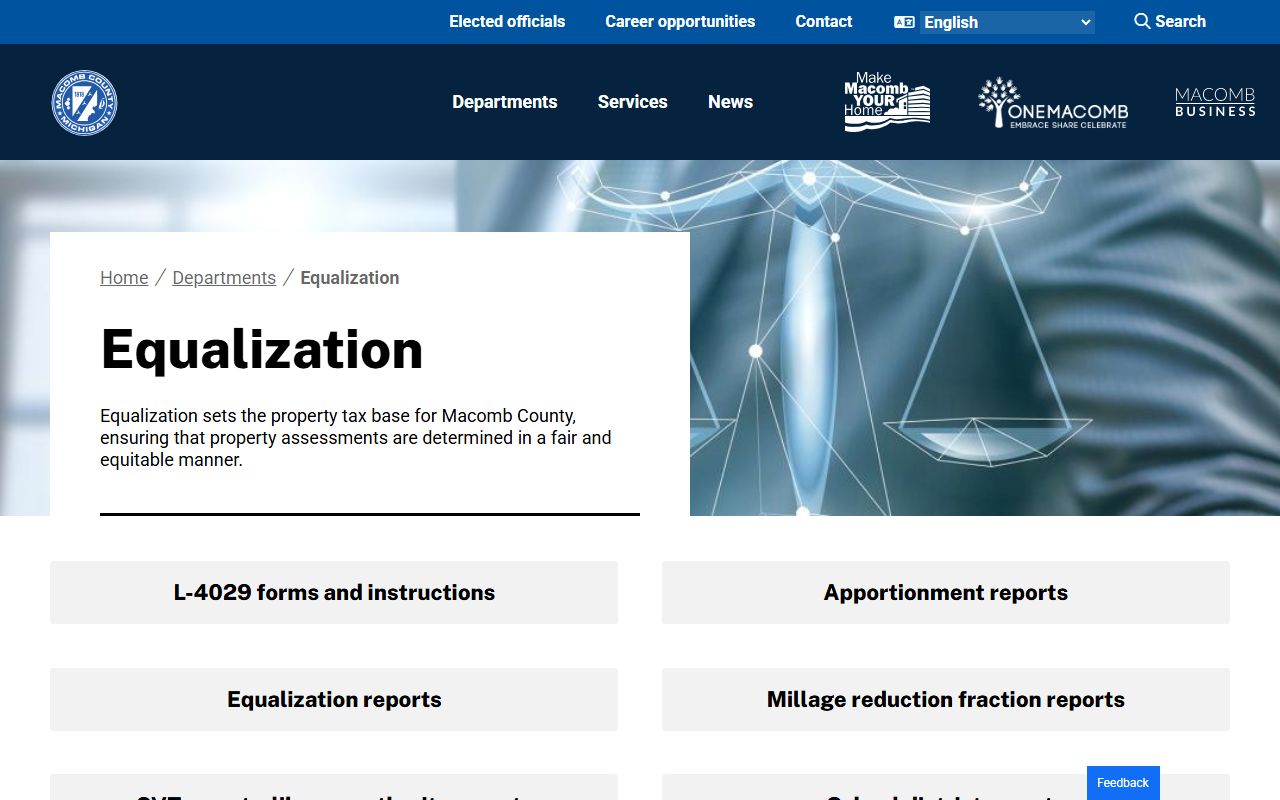
The portal is maintained by the county and updated regularly to reflect current assessment year data across all local units.
Macomb County Equalization Department
Director Anthony C. Plymouth leads the Macomb County Equalization Department. The department conducts the annual review of assessments from all local units in the county to ensure they meet the state standard. Under MCL 211.1, all Michigan property must be assessed at 50% of its true cash value. The Equalization Department reviews data from each city and township and submits equalization factors to the state every spring.
The office maintains Macomb County's property database, handles exemption applications, and manages special assessment records. Given the county's size and growth, the Equalization Department is one of the busiest in the state. Public records are available for review at the Mt. Clemens office on the 7th floor of the county building. The department can also answer questions about how specific parcels were valued and whether any exemptions are on file.
| Office | Macomb County Equalization Department |
|---|---|
| Director | Anthony C. Plymouth |
| Address | 1 S. Main St., 7th Floor, Mt. Clemens, MI 48043 |
| Phone | 586-469-5260 |
| Property Search | macombgov.org - Equalization |
| GIS Mapping | Macomb County GIS |
Macomb County Register of Deeds
The Macomb County Register of Deeds records all real estate instruments affecting property in the county. Deeds, mortgages, liens, land contracts, and easements are on file here. When a property transfers, the new owner must file a Property Transfer Affidavit (Form L-4025) with the local assessor within 45 days. This step is required by Michigan law and triggers the uncapping of taxable value for the next tax year. Failing to file on time results in a penalty.
Register Karen A. Spisak can be reached at 586-469-7953. The Register of Deeds office is at 32 Market St. in Mt. Clemens. Information about recorded documents and how to request copies is available at macombgov.org. Recording fees in Michigan are $30 per document. Plain copies are $1 per page and certified copies are $5. All recorded instruments are public records.
Note: Macomb County processes a large volume of real estate documents each year. Calling ahead to confirm processing times and any requirements before an in-person visit is recommended.
Property Tax Assessment in Macomb County
Michigan's Tax Day is December 31 under MCL 211.30. Ownership and use of property on that date determine how it is assessed. Local assessors in each of Macomb County's cities and townships value parcels as of December 31, and the Equalization Department reviews those values each spring. Assessment notices go out in February.
Taxable value in Michigan can only increase by the rate of inflation or 5%, whichever is less, in years without a transfer. When property sells, taxable value uncaps and resets to the assessed value for the next tax year. In Macomb County, this can produce a significant jump for buyers, especially in cities with active markets like Warren and Sterling Heights. The free Michigan Property Tax Estimator can help buyers calculate what taxes will look like after a sale. Full guidance on assessment rules is at michigan.gov/taxes/property-tax.
Macomb County includes many incorporated cities and townships, including Warren, Sterling Heights, Clinton Township, Macomb Township, Chesterfield, Shelby Township, and others. Each local unit has its own assessor who applies state rules locally and submits data to the county annually.
Property Tax Exemptions in Macomb County
The Principal Residence Exemption (PRE) is the most widely used tax reduction for Macomb County homeowners. Under MCL 211.7u, the PRE removes 18 mills from your school operating tax. File Form 2368 with your local city or township assessor by June 1. The property must be your primary home and the address on your voter registration and driver's license. The PRE does not transfer automatically when you move, so filing a new form at a new address is required.
The Poverty Exemption is available to low-income homeowners in Macomb County who meet the income and asset tests set by each local unit. File Form 5737 and Form 4988 with your assessor. The Board of Review decides poverty exemption requests each March. Veteran exemptions are also available for disabled veterans and their surviving spouses under Michigan law. Check with your local assessor about whether agricultural exemptions under MCL 211.7v apply to any rural parcels in the county's outer townships.
Appealing a Macomb County Property Assessment
Macomb County property owners who believe their assessment is too high can appeal. The March Board of Review is the first step in each city and township. It meets annually to hear protests in person or by written submission before the local deadline. Documented evidence of your property's market value, such as a recent appraisal or comparable sales data, strengthens your case. The Board has authority to reduce values when the evidence supports it.
If the Board of Review does not resolve the issue, you can appeal to the Michigan Tax Tribunal. Call the MTT at 517-335-9760. The deadline for residential property appeals is July 31. Commercial and industrial property must be appealed by May 31. Your rights through each stage of the process are defined by the Property Taxpayer's Bill of Rights under MCL 205.735.
Macomb County Property Tax Payments
The Macomb County Treasurer handles delinquent property taxes after local units forward them. Summer taxes are generally due in September and winter taxes in February, but exact deadlines vary by city and township. For current tax bills, contact your local assessor or treasurer. For delinquent amounts, the Macomb County Treasurer can be reached at 586-469-5190. More information is at macombgov.org/departments/treasurer.
Delinquent taxes accrue interest and fees once transferred to the county. The Treasurer's office handles payment plans and the forfeiture process. Properties in Michigan enter forfeiture after one year of unpaid county-level delinquency and become subject to foreclosure after three years. Macomb County property owners who fall behind should contact the Treasurer promptly to work out a resolution and stop the amount from growing.
Note: Current tax bills in Macomb County are issued by each individual city or township. Delinquent tax information is available through the county Treasurer's office after the delinquency is forwarded from the local unit.
Cities in Macomb County
Macomb County has several large cities and communities. The following cities have dedicated pages on this site with more detail on local property tax records and resources:
Other communities in Macomb County include Chesterfield Township, Shelby Township, Utica, New Baltimore, Richmond, and Eastpointe. These municipalities do not have individual city pages on this site, but their property tax records are accessible through the county equalization portal.
Nearby Counties
These counties share a border with Macomb County. Each county maintains its own equalization records and property tax system. Verify which county a parcel falls in before searching, especially for properties near county lines.